

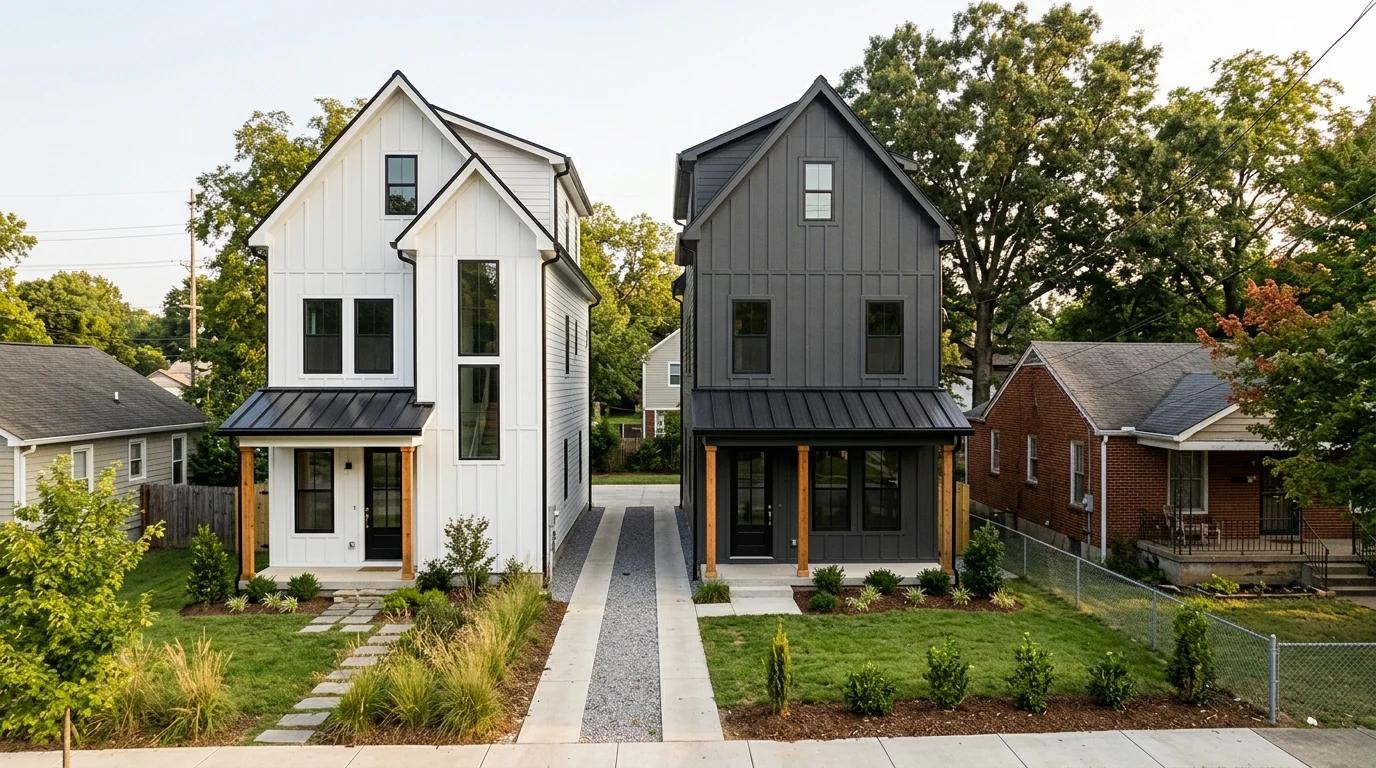
An HPR, short for horizontal property regime, is the legal structure that lets two homes built on one Nashville lot be owned and sold separately. The lot is not subdivided: ownership of the units is divided by a master deed, and a regime created after January 1, 2009 is a condominium under the Tennessee Condominium Act of 2008, even when the two homes stand apart and look like ordinary houses.
That structure explains what surprises people about the narrow, two-to-a-lot homes known around Nashville as tall and skinnies: why a detached house can come with bylaws, why the yard beside it may not be entirely yours, and why a lender or insurer can ask questions a house on its own lot does not usually raise. Every rule below carries its source. Where the public record does not answer a question, this guide frames it as a question to ask.
What a horizontal property regime actually is
A conventional subdivision divides land into separate lots. Metro Planning defines a subdivision as land divided or proposed to be divided into two or more lots or parcels of less than five acres. An HPR does something different: it leaves the zoning lot whole and divides ownership of the dwellings on it by master deed. From the street it can look like two houses on two lots. On paper it is one lot, one regime and two units.
The name is older than the law that now governs it
The phrase comes from Tennessee’s Horizontal Property Act of 1963, Tenn. Code Ann. 66-27-101 through 66-27-123. Public Chapter 766 of 2008 made those sections Part 1 of Chapter 27 and enacted the Tennessee Condominium Act of 2008 as Parts 2 through 5, beginning at 66-27-201. Under 66-27-202, the 2008 Act applies to condominiums created after its January 1, 2009 effective date, and the 1963 sections do not. A regime created before 2009 can elect into the new Act by amending and restating its master deed, bylaws and plat.
HPR survives as Nashville shorthand, and Metro Code 6.28.030 still refers to dwellings created within a horizontal property regime under 66-27-101 and following. But a two-home regime created since 2009 is, legally, a condominium regime under the 2008 Act. The first question to ask about any unit is therefore a simple one: when was the regime created, and which statute governs it?
| Structure | The land | Ownership of the dwellings | Governing rule |
|---|---|---|---|
| Two lots created by subdivision | Divided into separate lots | Each lot, and the home on it, owned separately | Metro Subdivision Regulations |
| Horizontal property regime | One zoning lot, not subdivided | Units owned separately under a master deed | Tenn. Code Ann. 66-27; the Condominium Act of 2008 for regimes created after January 1, 2009 |
| Detached accessory dwelling unit (DADU) | One single-family lot | Cannot be divided from ownership of the principal dwelling | Metro Code 17.16.030.G, as amended by BL2025-1007 |
Why two homes can share one Nashville lot
The answer is in Title 17 of the Metro Code, Nashville’s zoning code, and it turns on a single letter. Metro Planning’s zoning classifications separate the districts this way:
- RS districts, from RS80 down to RS3.75 and their -A variants, are single-family residential. Two-family dwellings are not allowed.
- R districts, from R80 down to R6 and their -A variants, are one- and two-family residential. Duplexes are allowed.
- RM districts, RM2 through RM100-A, are multi-family districts expressed in units per acre.
The operative rule is Metro Code 17.16.030.D: in the AG, AR2a and R districts, two-family dwellings may be permitted on any lot legally created as prescribed by state law or within an approved subdivision final plat, provided the lot meets the minimum lot size standard of the district. Table 17.12.020A sets those minimums, among them 6,000 square feet in R6, 8,000 in R8 and 10,000 in R10, and where an RS and an R district carry the same number, such as RS10 and R10, they share the same minimum. Single- and two-family dwellings in these districts carry a three-story maximum height and a 20-foot rear setback.
Put those rules together and the economics of Nashville infill follow. An older house on an R-zoned lot that meets its district minimum sits on land where two dwellings may be permitted, and an HPR lets a builder sell each of them separately. That is why the strongest bidder for a modest house can be a builder rather than a household, the situation covered in the section on when your lot is worth more than your house in Selling a Home in Nashville: The Complete 2026 Guide.
Why they come out tall and skinny
Tall and skinny is a nickname, not a zoning term. The shape is geometry. Two homes that share the width of one lot, each held to the height limit and setbacks, have little room to go out, so they go up, to the three-story cap or lower where an overlay applies.
Attached or detached
Metro Codes’ short-term rental permit-types page describes two-family units as including detached duplexes divided under a horizontal property regime, so detached HPR pairs exist in Nashville. Whether a particular design, attached or detached, can be permitted on a particular lot today is a question for Metro Codes. Metro Code 17.16.030.D says only that two-family dwellings may be permitted on legally created lots meeting the district minimum.
Overlays are layered over base zoning
Metro Codes notes that neighborhood conservation, historic preservation, urban design and urban zoning overlays apply in addition to base zoning. Metro lists 27 Neighborhood Conservation Zoning Overlays, among them Lockeland Springs-East End, and nine Historic Preservation Zoning Overlays, among them Edgefield and Germantown. In a conservation overlay, a preservation permit is required for new construction, additions, demolition and relocation, and the commission does not review paint color. A Contextual Overlay, under Metro Code 17.36.450 through 17.36.500, caps primary-structure height at the lesser of 35 feet or 125 percent of the average height of the abutting principal structures, with a 27-foot floor, and caps building coverage at 150 percent of the average of the abutting lots, while leaving the base-zoning uses unchanged. Two lots with the same base zoning can therefore support different infill.
BL2025-1005 and the new Residential Neighborhood districts
On December 4, 2025, Metro Council passed BL2025-1005, which created two families of design-based zoning districts, Residential Neighborhood (RN) and Residential Limited (RL), now codified at section 17.38.010 of the Metro Code. The ordinance takes effect upon publication of notice after final passage. Instead of counting dwellings alone, the new districts are organized around building types:
| Districts | Building types |
|---|---|
| RN1 (suburban) and RN2 (urban) | Single Family, Two Family, Townhouse, House Court, Townhouse Court and Plex House, plus Manor House in RN2 only |
| RL1 (suburban), RL2 (urban) and RL3 (center) | Adds Multiplex and Low-rise Courtyard Flats, plus Low-rise Flats in RL3 only, with a voluntary attainable-housing incentive for eligible building types |
In both families, not-owner-occupied short-term rentals are prohibited, owner-occupied short-term rentals are allowed only with the Single Family building type, and DADUs are allowed with Single Family building types. Two cautions. A district’s rules reach only property zoned into it, which the Parcel Viewer’s zoning entry with Current status shows. And Two Family in an RN district should be read against the Chapter 17.38 standards, not assumed to match two-family in an R district.
DADUs under BL2025-1007: the backyard cottage is not an HPR
Council passed BL2025-1007 on the same date. Both it and an HPR put a second dwelling on one lot, but on the question that matters at resale they are opposites.
- Ownership. One DADU is allowed accessory to a single-family principal structure. It cannot be divided from ownership of the principal dwelling, both must be owned by the same person or entity, one of the two must be owner-occupied, and a restrictive covenant must be recorded before a permit issues.
- Where. DADUs are allowed throughout the Urban Services District. In the General Services District outside it, a DADU still requires a DADU overlay of at least 30 contiguous lots or a Specific Plan. BL2026-1257, passed April 21, 2026, extended eligibility to legally created lots with non-conforming lot area.
- Size and form. Living space may not exceed 700 square feet on lots under 10,000 square feet or 850 square feet on lots of 10,000 square feet or more, and may not exceed the size of the principal structure. The DADU sits behind the principal structure, with its ridge below the primary structure and no higher than 27 feet.
- Rental. A new DADU on a single-family, RN or RL lot cannot be used as an owner-occupied short-term rental.
Two points people get wrong
A DADU may have its own utility meters and still cannot be divided from ownership of the principal dwelling. And because no DADU is permitted where two principal structures already exist, a lot already carrying a two-home HPR is not a candidate for a backyard cottage as well.
On an RS-zoned lot in the Urban Services District the distinction is practical. Two-family dwellings are not allowed, so a two-unit HPR is not available at the district level, while a DADU may be. A DADU adds a dwelling that stays with the house; it cannot be sold on its own.
What the HPR master deed and bylaws govern
The master deed is the instrument that divides ownership of the units, and the master deed, bylaws and plat are the three documents the 2008 Act names when a pre-2009 regime elects into it. In a two-home regime they do the work a lot line does in a subdivision: they say what is yours, what is shared and how the owners decide. Read the documents themselves, with every amendment, rather than a listing summary of them.
Questions to put to the master deed, bylaws and plat
- Where does the unit boundary sit, and does the plat match what was built?
- What is shared: the driveway, side yards, utility lines, drainage, fencing, the ground under each home?
- Who maintains and pays for roofs, exteriors and the shared drive, and how are shared costs split?
- Do the documents call for one insurance policy covering both structures, or a policy for each unit?
- How do the owners vote, and what happens when two owners deadlock?
- What is restricted: rental use, additions, exterior changes, fences, parking?
- How are the documents amended, and have they been?
- If the regime was created before January 1, 2009, has it elected into the 2008 Act?
In a two-home regime, the body of owners the bylaws govern can be just you and your neighbor. Ask whether the owners keep any shared account, insurance records or written decisions, because a buyer’s lender or insurer may ask to see them.
What owning an HPR unit means for a buyer
You are buying a unit in a regime, not a lot of your own, and a detached HPR home in a regime created after January 1, 2009 is still a unit in a condominium regime. The documents above set what you may use, change and add. Four further questions belong on the list before you are committed:
- Insurance. Ask your insurance agent what policy the unit needs, how it fits with the master deed, who covers a shared roof line or wall on an attached pair, and how a claim works when damage starts next door.
- Lending. Ask your lender whether the loan will be underwritten as a condominium unit or a single-family home, which regime documents the underwriter will require, and whether a pre-2009 regime that never elected into the 2008 Act affects the loan.
- Appraisal. Ask which comparable sales the appraiser will use: other HPR units, detached homes on their own lots, or both.
- Property tax. Ask the Metropolitan Nashville Assessor of Property how each unit is appraised and assessed. The Parcel Viewer shows a parcel’s tax district and assessment history, and The 2025 Davidson County Reappraisal Explained covers how a bill is computed.
Do not buy on a rental assumption either. Metro Code 6.28.030 sets separate short-term rental rules for two-family dwellings and for dwellings created within a horizontal property regime, and the RN and RL districts prohibit not-owner-occupied short-term rentals. The permit rules are in Nashville Short-Term Rental Rules and Investment Guide 2026, and eligibility for one parcel is confirmed with Metro Codes and the Metro Short Term Rental Property Eligibility Viewer.
Buying new from the builder? Under 66-5-209, the first sale of a dwelling is excluded from the Residential Property Disclosure Act where the builder offers a written warranty, so get the warranty in writing, read what it covers, and have the unit inspected regardless. New Construction in Middle Tennessee covers builder contracts and who the on-site agent represents.
Looking in East Nashville or The Nations? The neighborhood pages are a place to start, but a neighborhood name tells you nothing about the zoning of one lot. Run the parcel.
Know what the parcel says before you set a price
A valuation for an HPR unit, or for a lot a builder may want, starts with the zoning, the regime documents and the sales a buyer will actually compare it against.
What selling an HPR unit involves
Selling one unit of a two-home regime is a residential sale with more paperwork, and the paperwork is worth assembling before you list.
Disclosure and agency
Tennessee’s Residential Property Disclosure Act, Tenn. Code Ann. 66-5-201 and following, requires the owner to furnish a purchaser either a disclosure statement covering the condition of the property, including material defects known to the owner, or, only where the purchaser waives disclosure, a disclaimer statement. The owner is not required to undertake an independent investigation or inspection to make the disclosures. The exclusions in 66-5-209 are defined by the kind of transfer, and none is written for HPR or condominium units as such, though two can arise on infill: a builder’s first sale with a written warranty, and a transfer where the owner has not resided on the property at any time within the three years before it. Whether one fits your sale is a question for your agent and your attorney. Since July 1, 2024, Public Chapter 510 has also required a seller to disclose a known sinkhole in writing before entering into a contract.
Agency status is its own disclosure. Under 62-13-405, a licensee assisting an unrepresented buyer or seller must disclose their agency status verbally before providing real estate services and confirm it in writing, and under 62-13-403 a licensee must disclose to each party adverse facts of which the licensee has actual notice or knowledge. A known dispute with the other owner, or a known problem with a shared element, belongs in the conversation with your agent early rather than late.
Assemble the regime file before you list
- The master deed, bylaws and plat, with every amendment.
- Any written agreements or records between the owners on shared costs, maintenance or insurance.
- The insurance declarations for your unit and for any shared policy.
- Permits for the original build and any later work, searchable on Metro’s ePermits portal.
- An answer on whether the documents give the other owner any right when a unit sells, such as notice, approval or a right of first refusal.
Then price against the sales a buyer will treat as the real alternative, other units and nearby detached homes on their own lots, adjusted for what the regime documents give and take away. More on selling with the team is on the sellers page.
How to check one lot, step by step
- Search the Nashville Parcel Viewer at maps.nashville.gov by address, parcel ID, owner, street or intersection.
- Read the zoning entry with Current status and identify the district: RS, R, RM, RN, RL or another.
- Check the Overlay District field, since overlays apply in addition to base zoning.
- Compare the lot area with the Table 17.12.020A minimum, remembering that 17.16.030.D also requires a legally created lot.
- Review the permit history in the Parcel Viewer or on Metro’s ePermits portal.
- Confirm the result with Metro Codes, and with a real estate attorney or zoning professional, before anyone relies on it to buy, build or price.
District, not parcel
Everything on this page describes zoning districts and statutes, not any specific property. HPR eligibility, overlays, lot area and short-term rental eligibility vary lot by lot, and a statement about a district is not a statement about your address. Verify a specific parcel through the Nashville Parcel Viewer and the Metro Short Term Rental Property Eligibility Viewer and, for flood questions, the FEMA Map Service Center, then confirm with Metro Codes.
Frequently asked questions
An HPR, or horizontal property regime, is the legal structure that lets two or more dwellings on one zoning lot be owned separately. The lot is not subdivided. A recorded master deed designates the units for separate ownership; under the Tennessee Condominium Act of 2008 everything outside the units is a common element owned in undivided shares by the unit owners, and the documents can reserve a yard or drive to one unit as a limited common element. In Nashville it is how a duplex on one lot, including a pair of the narrow homes often called tall and skinny, can be sold as two separately owned units. Metro Code 6.28.030 refers to such dwellings under Tenn. Code Ann. 66-27-101 and following.
For a regime created after January 1, 2009, legally yes. Public Chapter 766 of 2008 made the Tennessee Condominium Act of 2008, Tenn. Code Ann. 66-27-201 and following, apply to condominiums created after that date and withdrew the 1963 Horizontal Property Act from them. The 2008 Act defines a unit as a physical portion of the condominium designated for separate ownership, with no requirement that units share a wall, so a two-home regime created since then is a condominium regime whether the homes are attached or detached. Older regimes remain mainly under the 1963 Act, although listed sections of the 2008 Act apply to them for events after January 1, 2009, and they can elect fully into the 2008 Act by amending and restating their master deed, bylaws and plat.
It depends on the zoning district and the lot. Under Metro Code 17.16.030.D, two-family dwellings may be permitted in the AG, AR2a and R districts on any legally created lot that meets the district minimum lot size, for example 6,000 square feet in R6 and 8,000 square feet in R8. RS districts are single-family only. The RN districts created by BL2025-1005 include a Two Family building type. Check the lot in the Nashville Parcel Viewer and confirm with Metro Codes.
Some are. Metro Codes describes two-family units as including detached duplexes divided under a horizontal property regime. Whether a new detached pair can be permitted on a particular lot today is a separate question, because Metro Code 17.16.030.D says only that two-family dwellings may be permitted on legally created lots meeting the district minimum. Confirm the design and the lot with Metro Codes before buying or pricing on it.
No. Under Metro Code 17.16.030.G, as amended by BL2025-1007, a detached accessory dwelling unit cannot be divided from ownership of the principal dwelling, both must be owned by the same person or entity, one of the two must be owner-occupied, and a restrictive covenant must be recorded before a permit issues. An HPR is the structure that lets two dwellings on one lot be owned separately, and no DADU is permitted where two principal structures already exist.
Under Metro Code 17.16.030.G, as amended by BL2025-1007 (passed December 4, 2025), DADU living space may not exceed 700 square feet on lots under 10,000 square feet or 850 square feet on lots of 10,000 square feet or more, and may not exceed the size of the principal structure. DADUs are allowed throughout the Urban Services District and, outside it, only in a DADU overlay or through a Specific Plan. A new DADU on a single-family, RN or RL lot cannot be used as an owner-occupied short-term rental.
The Tennessee Residential Property Disclosure Act, Tenn. Code Ann. 66-5-201 and following, requires the owner to furnish either a disclosure statement covering the condition of the property, including known material defects, or, where the purchaser waives disclosure, a disclaimer statement. The exclusions in 66-5-209 are defined by the kind of transfer, such as a builder’s first sale with a written warranty, and none is written for HPR or condominium units as such. A seller covered by the Act must also disclose a known sinkhole in writing before contract.
Search the address in the Nashville Parcel Viewer and read the zoning entry with Current status. In R districts, two-family dwellings may be permitted on legally created lots meeting the district minimum; RS districts are single-family only; RN and RL are the design-based districts created by BL2025-1005. Check the Overlay District field too, since overlays apply in addition to base zoning, then confirm with Metro Codes before buying, building or pricing on it.
Related resources
Talk to the team about an HPR unit or an infill lot
Whether you are buying a unit, selling one, or wondering what a builder would see in your lot, the first conversation is about the specific property and the documents behind it. No obligation.
Sources
- Metro Nashville Planning Department, Zoning Classifications, Subdivision Regulations, Overlays and Contextual Overlays pages, nashville.gov
- Metro Nashville Code, Title 17 (Zoning): Table 17.12.020A, sections 17.16.030.D and 17.16.030.G, 17.36.450 through 17.36.500, 17.36.730 and 17.38.010, Municode
- Metro Council ordinances BL2025-1005 (Substitute, including Exhibit C) and BL2025-1007 (Second Substitute, as amended by Amendment A), both passed December 4, 2025, and BL2026-1257, passed April 21, 2026, nashville.legistar.com
- Tennessee Public Chapter 766 (2008), Tennessee Condominium Act of 2008, effective January 1, 2009, publications.tnsosfiles.com
- Tenn. Code Ann. 66-27-101 through 66-27-123 (Horizontal Property Act) and 66-27-201 and following (Tennessee Condominium Act of 2008)
- Metro Nashville Code 6.28.030 and Metro Codes short-term rental permit types, nashville.gov and Municode
- Metro Codes, Detached Accessory Dwelling Unit permitting page, nashville.gov
- Metro Historic Zoning Commission Handbook, revised 2022, and Metro Planning Districts and Design Guidelines page, nashville.gov
- Nashville Parcel Viewer, maps.nashville.gov, and Metro Codes ePermits, epermits.nashville.gov
- Tenn. Code Ann. 66-5-201 through 66-5-212 (Residential Property Disclosure Act); 62-13-403 and 62-13-405 (agency duties and disclosure)
- Public Chapter 510 (2024), known sinkhole disclosure, effective July 1, 2024, publications.tnsosfiles.com
Figures are current as of the dates stated. Zoning ordinances, statutes and municipal codes change. This guide is general information about horizontal property regimes and residential zoning in Nashville and is not legal, tax or zoning advice. Confirm anything specific to your property or your circumstances with the appropriate professional and with Metro Codes or your county’s offices.