

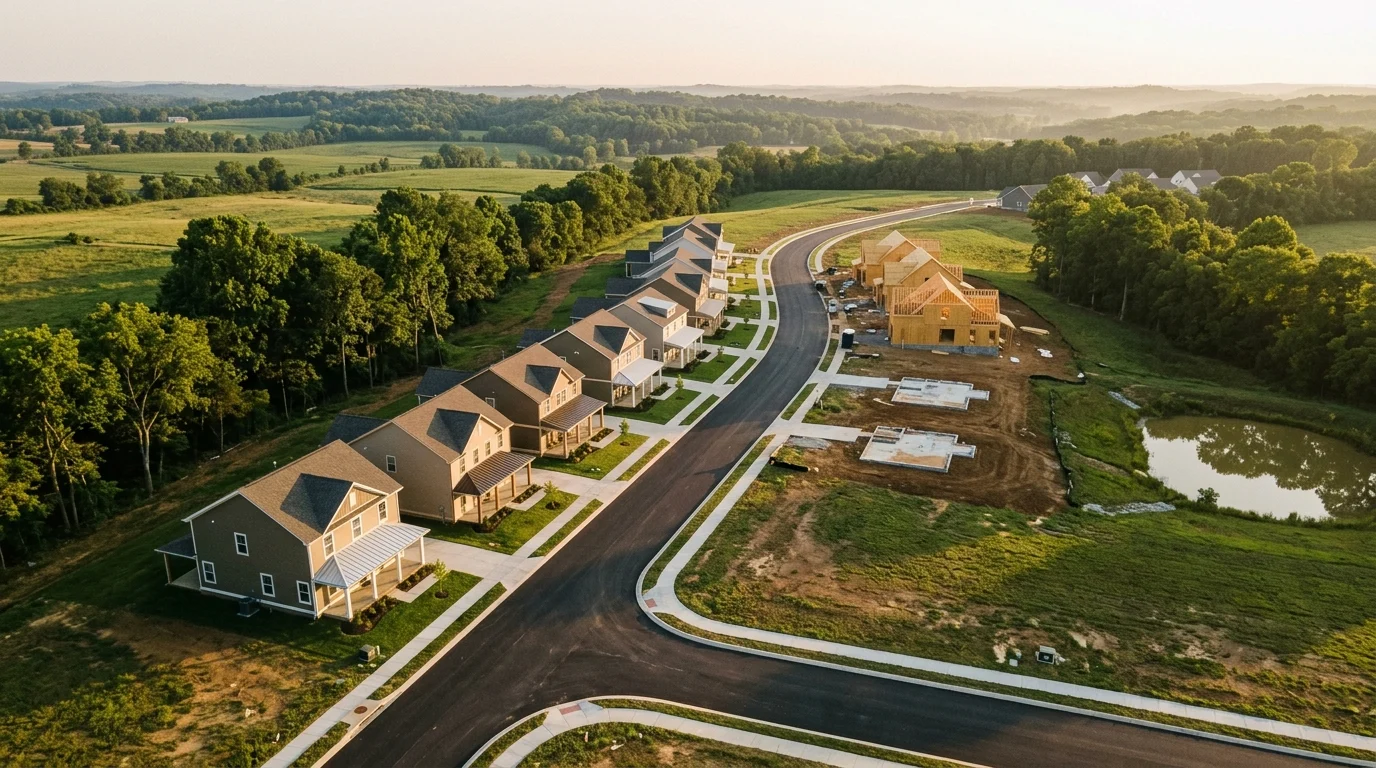
Choose a sales and marketing team for a Nashville development by what it will deliver at each stage, in writing, before you need it. The right team shapes the community from land and entitlement through product, pricing, launch, on-site sales, absorption reporting and closeout, and it knows the Tennessee rules that govern what its agents say and what its marketing may claim. This guide covers that work stage by stage, the Tennessee specifics that matter, and the questions to ask in the interview.
It is written for the developer or builder with roughly 40 to 400 lots or units in Middle Tennessee. It quotes no fees, absorption rates or sales figures, because those depend on the site, the product and the agreement. It offers the structure of the engagement instead, so two proposals can be compared on the same terms.
What a development sales team is responsible for
A resale listing agent sells one finished property. A development sales team sells a program: homes or lots that do not all exist yet, released in phases, priced against competition that changes while the community sells. A team that performs on the sales floor but is absent from the land, product and pricing decisions is doing a fraction of the job.
| Stage | What the team delivers | What you should see in writing |
|---|---|---|
| Land and entitlement | What buyers will pay for on this site, before the land plan is fixed | A product recommendation and its comparable set |
| Product and plans | Plan mix, square footage, elevations, features and options | Recommendations tied to competing inventory |
| Pricing and releases | Base prices, lot premiums, release schedule, price-increase rules | A pricing model and release plan you approve |
| Pre-launch and launch | Interest list, brand, website, signage, launch sequence | A marketing plan, budget split and compliance review |
| On-site sales | Staffing, agency disclosure, cooperating-agent policy, contracts | A staffing schedule and registration policy |
| Absorption reporting | Traffic, contracts, cancellations, closings, competing supply | A sample report and a fixed cadence |
| Closeout | The final homes, lots, models and sales center | A closeout plan agreed at launch |
The right-hand column is the test. If a team cannot say what it will put in writing at a stage, it is not planning to do that stage.
Stage 1: Land and entitlement
The sales team’s first contribution is a question to ask before closing on the land: what will buyers here pay for, and does the zoning allow it? A land plan drawn for the wrong product is expensive to unwind, and the sales team hears daily what buyers ask for and walk away from.
In Davidson County, entitlement starts with the base zoning district under Title 17 of the Metro Code. At district level:
- RS districts, from RS80 down to RS3.75, are single-family only.
- R districts, from R80 down to R6, allow two-family dwellings on any legally created lot that meets the district’s minimum lot size, under Metro Code 17.16.030.D. That rule is the mechanism behind duplex infill.
- RM districts are multi-family, expressed in units per acre.
- BL2025-1005, passed by Metro Council on December 4, 2025, created the Residential Neighborhood (RN1, RN2) and Residential Limited (RL1, RL2, RL3) districts, codified at 17.38.010 and organized by building type, from townhouses, house courts and plex houses to multiplexes and low-rise courtyard flats.
Overlays are layered over the base district. Metro Planning lists five non-historic overlay families under Chapter 17.36, including Contextual Overlays and Planned Unit Developments, and Nashville has 9 Historic Preservation and 27 Neighborhood Conservation zoning overlays. Even a Neighborhood Conservation overlay, the least restrictive, requires a preservation permit for new construction, and the Metro Historic Zoning Commission Handbook indicates that infill goes to the full commission: a schedule question as much as a design one.
If the project divides land, Metro Planning defines a subdivision as any land divided into two or more lots or parcels of less than five acres, and states that subdivision review does not alter zoning entitlements: a plat does not create density the district does not allow. Outside Davidson County, check each jurisdiction’s own code.
Check the parcel, not the district
Zoning, overlays, lot size, horizontal property regime eligibility and flood mapping are determined parcel by parcel, and no sales team should tell a developer or a buyer what a specific parcel allows. The Nashville Parcel Viewer shows current zoning, zoning history, overlays and permits for an address or parcel ID. Short-term rental eligibility belongs to the Metro Short Term Rental Property Eligibility Viewer and Metro Codes, and flood mapping to the FEMA Map Service Center and Metro’s flood tools. The guide to reading the flood map for one address walks through that step.
Stage 2: Product and plan input
Product input is where the sales team’s knowledge of the buyer becomes a drawing. The useful version is specific: which plans should be larger or smaller, which features buyers expect at this price band, which options they will pay for, and which elevations will stand apart from the competition a buyer tours the same weekend.
Code edition matters when a plan set moves between jurisdictions. The Tennessee State Fire Marshal’s statewide minimum residential code is the 2018 International Residential Code with amendments, effective July 16, 2020, while Metro Nashville has adopted the 2024 International Residential Code with local amendments by ordinance BL2025-898. Check a plan set against the edition each permitting jurisdiction has adopted.
Ownership structure is a product decision
How a buyer will hold title shapes who can buy and how the home is marketed. Attached and two-on-one-lot product often uses a horizontal property regime, which divides ownership of units on one zoning lot by master deed rather than by subdividing the lot. Regimes created after January 1, 2009 are condominiums under the Tennessee Condominium Act of 2008, Tenn. Code 66-27-201 and following. The explainer on horizontal property regimes and tall and skinny homes covers the mechanics.
Under BL2025-1007, passed December 4, 2025, one detached accessory dwelling unit is allowed with a single-family home throughout the Urban Services District, but it cannot be separated from ownership of the principal dwelling, one of the two dwellings must be owner-occupied, and its living space is capped at 700 square feet on lots under 10,000 square feet and 850 square feet on lots of 10,000 square feet or more, and never larger than the principal structure. A new DADU on a single-family, RN or RL lot cannot be used as an owner-occupied short-term rental, and non-owner-occupied short-term rentals are prohibited in the RN and RL districts. A team that markets a DADU as a separately saleable unit, or a new DADU as short-term rental income, is marketing something the code does not allow.
Stage 3: Pricing and the release schedule
Pricing a community is not pricing a house. It is a model: base prices by plan, premiums by lot, the order of releases, and the conditions under which prices rise between them. The sales team should build that model from the competing supply a buyer will actually see and defend it with the comparable set, not adjectives.
Two public sources show that supply. Greater Nashville REALTORS publishes monthly figures for nine Middle Tennessee counties, and its July 2026 release reported 15,636 active listings at month end; a new community competes with that resale inventory too. For Davidson County, Metro’s Building Permits Issued dataset on data.nashville.gov, queried September 12, 2026, recorded 3,704 permits of the type Building Residential – New in calendar 2024 and 3,734 in calendar 2025. That type includes accessory dwelling units, duplexes, townhomes and accessory structures as well as single-family homes, so it measures permitting activity, not houses. Each record carries the parcel, issue date and ZIP code, so it can be filtered to a submarket.
What a release schedule should answer
- Which lots and plans open first, and why. The first release sets the price reference for everything after it.
- What triggers the next release: a number of contracts, a date or a construction milestone, agreed in advance.
- How price increases are decided and communicated, including to buyers under contract and to cooperating agents.
- What the team will recommend if the pace falls behind plan, before incentives become the default answer.
Stage 4: Pre-launch and launch
Pre-launch is where demand is measured before it is spent. An interest list or waitlist gives the team names, preferences and price reactions before the first price sheet is final, while there is still time to adjust options or release order. The team’s own Bison Ridge page, for example, is built around a waitlist and a guide request.
Launch is a sequence rather than an event: the interest list gets first access, cooperating agents get the materials they need, and public marketing follows. If inventory will be listed in Realtracs, the MLS, agree who keeps it current: TREC Rule 1260-02-.12(5)(c) requires advertised listing information to be current and accurate.
Community marketing is regulated advertising
When a brokerage markets a community, the Tennessee Real Estate Commission’s advertising rule, Rule 1260-02-.12 in the September 2025 revision, applies. It defines advertising to include signs, flyers, websites, social media and video, and requires the firm name and the firm telephone number on file with the Commission, with the firm name in letters the same size or larger than any team name. On a website both must appear on each page. Rule 1260-02-.12(7) prohibits unsubstantiated selling claims and misleading statements or inferences. A post that promises a sell-out date or implies an investment return is a compliance question for the supervising principal broker.
Bring this guide to the conversation
Read how the team’s Builders and Developers division describes its role, then test it against the seven stages and the questions below.
Stage 5: On-site sales and agent co-operation
On-site sales is the stage a developer sees. The differences are in the details: who staffs the sales center and when, how walk-in buyers are qualified, how contracts are tracked, and how the team treats agents who bring buyers.
Agency disclosure at the sales center
Tennessee law governs the first conversation with a buyer who walks in alone. Under Tenn. Code 62-13-405, a licensee who personally assists a prospective buyer who is not represented by any licensee must verbally disclose whether the licensee is acting as a facilitator, agent, subagent or designated agent before providing any real estate services, and must confirm that status in writing, with a signed receipt, before preparing an offer. The written disclosure is not itself an agency agreement.
Tenn. Code 62-13-403 adds duties owed to all parties, including a buyer the licensee does not represent: reasonable skill and care, disclosure of adverse facts of which the licensee has actual notice or knowledge, and honesty and good faith. A sales team cannot be instructed to stay quiet about a known adverse fact. The buyer’s side of this conversation is covered in the guide to builder contracts, warranties and who the on-site agent represents.
Cooperating agents
Settle three things in writing before launch. First, a registration policy: how an agent registers a buyer, what counts as the first visit, and how disputes are resolved. Second, compensation: the National Association of REALTORS consumer guide states that an offer of compensation to another agent is not mandatory, requires the seller’s written approval, and cannot be listed on Multiple Listing Services, though it may be communicated on flyers, signs, brokerage websites or by phone or email. Third, listing authorization: TREC Rule 1260-02-.12(3)(e) bars a licensee from advertising another licensee’s listing without written authorization from the listing agent or broker.
The contract, the warranty and the deposits
New-home sales run on the builder’s contract, and its warranty terms govern. Tennessee’s implied warranty of good workmanship and materials, recognized in Dixon v. Mountain City Construction Co. in 1982, applies only when the written contract is silent, and the parties may contract in writing for different terms or expressly disclaim it. The sales team’s job is to present the written warranty exactly as written and never describe coverage the contract does not provide.
If the brokerage holds earnest money, TREC Rule 1260-02-.09 requires the principal broker to keep it in a separate escrow or trustee account and, absent a compelling reason, to disburse it, interplead it or turn it over to an attorney with instructions to interplead within 21 calendar days of a written request. Who holds deposits, and under which agreement, is a term to settle in the engagement.
Stage 6: Absorption tracking and reporting
Absorption is the rate at which a community turns inventory into contracts and closings, and the report is where a developer learns whether the pricing model is working. A useful report is short, arrives on a fixed day, and covers:
- Traffic and leads by source, including cooperating-agent registrations.
- Appointments and return visits, which move before contracts do.
- Contracts by plan and lot, against the release plan.
- Cancellations, with the reason for each.
- Closings scheduled against the construction calendar.
- Price feedback, and competing supply from the permit data and the monthly Greater Nashville REALTORS release, labelled by geography and month.
Ask to see a sample report before hiring, and agree on definitions early: an early cancellation, a reservation that never converts and a slipped closing all change the absorption figure depending on how they are counted.
Stage 7: Closeout
The last homes in a community sell in a different market from the first: late buyers choose among what is left, sometimes against resales from the community’s own first phase. Closeout is also when the models and any unsold spec homes have to be sold, and when a team’s attention can drift to its next launch. Plan it at launch: which homes are held for the final release, how the models will be sold, what incentive budget is reserved, and where homeowners direct questions under the builder’s written warranty after the last closing.
Contractor licensing: the Tennessee rule buyers ask about
Buyers and lenders ask who is building, so a sales team needs Tennessee’s licensing rules as well as the agency and warranty rules above. A contractor’s license is required before contracting, including bidding or negotiating a price, on projects of $25,000 or more under Tenn. Code 62-6-102 and 62-6-103, and the requirement expressly reaches anyone constructing residences for resale, lease or rent. A contractor who needed a license and lacked one can recover only documented actual expenses, proven by clear and convincing evidence, and has no mechanics lien. The owner-builder exemption covers a single residence built for the owner’s own use, not for resale. The separate Home Improvement license, for residential remodeling from $3,000 to $24,999 in nine counties including Davidson, excludes construction of a new home. Every builder on the program can be checked on the Board for Licensing Contractors’ public Verify search.
What to ask in the interview
- Which of the seven stages will you own, and will that scope be written into the agreement?
- Who, by name, staffs the sales center, and on what schedule?
- Who is the principal broker supervising the advertising, and how is it reviewed before it runs?
- Do you represent communities that will compete with ours for the same buyer?
- What product and pricing recommendation will you give before our plans are final, and in what form?
- What would make you recommend changing the plan mix or release order after launch?
- How will you disclose agency status to walk-in buyers, and how do your agents answer warranty questions?
- What is your cooperating-agent registration policy?
- May we see a sample report, and how do you count cancellations and slipped closings?
- Who owns the prospect database, the interest list and the marketing assets if the engagement ends?
- Which developers can we speak with about your work?
Be cautious of a team that answers with a promised sell-out date. TREC Rule 1260-02-.12(7) prohibits unsubstantiated selling claims and requires any offer, guaranty or warranty used to induce an agency relationship or contract to be made in writing with all pertinent details. A defensible projection comes with its assumptions attached.
How the engagement and compensation are structured
This guide quotes no rates. Compensation is negotiable, set in the written agreement, and shaped by the scope, the product and the length of the sell-out. The questions can be standardized:
- What is the fee based on: closed sales, contract price, a fixed monthly amount, or a combination?
- Is it earned at contract or at closing, and what happens when a contract cancels?
- Is the land, product and pricing work before launch billed separately, and is it credited against later fees?
- Which marketing costs does each side pay, and who approves the budget?
- How will cooperating-agent compensation be structured, approved in writing and communicated, given that it cannot be listed on the MLS?
- Are sales to buyers the developer brings, or bulk lot sales to builders, treated differently?
- What are the term and the termination rights, and what is owed on contracts written before termination that close after it?
- Is the engagement exclusive, and are there carve-outs?
The Erin Krueger Team’s Builders and Developers division
The Erin Krueger Team at Compass has a Builders and Developers page, which states that the team works with developers, investors and builders of all sizes in Downtown Nashville and neighboring counties, and that it can be involved in every step, from floor plan creation to design selections, or brought in only for sales and marketing. The team also markets Bison Ridge Resort and Residences, which its page describes as a private, gated community with homesites set within a Middle Tennessee wildlife reserve. If you are comparing teams, every question in this guide applies to this one as well.
Frequently asked questions
It carries a community from land to closeout. At the land and entitlement stage it tells the developer what buyers will pay for on that site. It then advises on product, plan mix and pricing, sets the release schedule, runs the pre-launch interest list and the launch, staffs on-site sales and works with cooperating agents, tracks and reports absorption, and plans how the final homes will sell. Some developers hire a team for every stage and some only for sales and marketing, so the scope belongs in the written agreement.
Before the product is final. A sales team’s market input is cheapest to act on at the land and entitlement stage, while lot sizes, product type and plan mix can still change. Once plans are drawn and priced, the team can only sell what was designed. A developer who brings a team in at launch still gets marketing and on-site sales, but gives up the buyer feedback that should shape what gets built.
Yes, for any project of $25,000 or more. Tenn. Code 62-6-103 makes it unlawful to engage in contracting without a license with a sufficient monetary limit, and it expressly covers anyone constructing residences on private property for resale, lease or rent. The Tennessee Board for Licensing Contractors requires the license before contracting, including bidding or negotiating a price. The owner-builder exemption covers a single residence built for the owner’s own use, not for resale. Licenses can be checked on the Board’s public Verify search.
Yes, under Tennessee case law, but it can be replaced or disclaimed in writing. In Dixon v. Mountain City Construction Co., 632 S.W.2d 538 (Tenn. 1982), the Tennessee Supreme Court recognized an implied warranty of good workmanship and materials that runs to the first buyer when a vendor in the business of building homes sells a recently completed home, one then under construction, or one it contracts to build. It is implied only when the written contract is silent, and the parties are free to contract in writing for different terms or to expressly disclaim any warranty. The written contract and warranty therefore control.
That depends on the agreement, and if no agent represents you, Tennessee law requires the agent to tell you. Under Tenn. Code 62-13-405, a licensee who personally assists a buyer who is not represented by any licensee must verbally disclose whether the licensee is acting as a facilitator, agent, subagent or designated agent before providing any real estate services, and must confirm that status in writing before preparing an offer. Under 62-13-403, a licensee owes every party duties that include reasonable skill and care, disclosure of adverse facts of which the licensee has actual notice or knowledge, and honesty and good faith.
Compensation is negotiable and is set in the written agreement between the developer or builder and the brokerage, so no rate quoted as a market norm should be relied on. Before signing, ask what the fee is based on, when it is earned, what happens when a contract cancels, which marketing costs each side pays, how cooperating-agent compensation is offered and approved, and what is owed on contracts written before a termination that close after it. Get every answer in writing.
No. The National Association of REALTORS consumer guide states that an offer of compensation, where the seller or the seller’s agent compensates another agent for bringing a buyer, cannot be listed on Multiple Listing Services. The same guide states that such offers are not mandatory, require the seller’s written approval, and may be communicated on flyers, signs, brokerage websites or by phone or email. A developer should decide in writing whether to make an offer and how the sales team will communicate it.
Related resources
Talk through your development
Bring your land, your entitlement status and your timeline. The first conversation is about your project and the questions in this guide, with no obligation.
Sources
- Tenn. Code Ann. 62-6-102, 62-6-103, 62-6-501 and 62-6-502; Tennessee Board for Licensing Contractors, license and Verify pages, tn.gov/commerce
- Dixon v. Mountain City Construction Co., 632 S.W.2d 538 (Tenn. 1982)
- Tennessee State Fire Marshal’s Office, adopted codes, tn.gov/commerce/fire; Metro Codes adopted codes list (BL2025-898), nashville.gov
- Metro Nashville Building Permits Issued dataset, data.nashville.gov, queried September 12, 2026
- Greater Nashville REALTORS, July 2026 housing report, greaternashvillerealtors.org
- Metro Planning zoning, overlay, historic zoning and subdivision pages; Metro Historic Zoning Commission Handbook (revised 2022); Nashville Parcel Viewer; nashville.gov
- Metro Code 17.16.030 and 17.38.010, Municode; ordinances BL2025-1005 and BL2025-1007, Metro Legistar
- Public Chapter 766 (2008), Tennessee Condominium Act of 2008, publications.tnsosfiles.com
- Tenn. Code Ann. 62-13-403 and 62-13-405
- Tennessee Real Estate Commission Rules of Conduct, chapter 1260-02, September 2025 revision
- National Association of REALTORS, Consumer Guide: Offers of Compensation, nar.realtor
Figures are current as of the dates stated. Statutes, codes and municipal ordinances change. This guide is general information about selling a new community in Tennessee and is not legal, zoning or construction advice. Confirm anything specific to your land, your project or your contracts with the appropriate professional and with Metro Codes, Metro Planning or your county’s offices.