

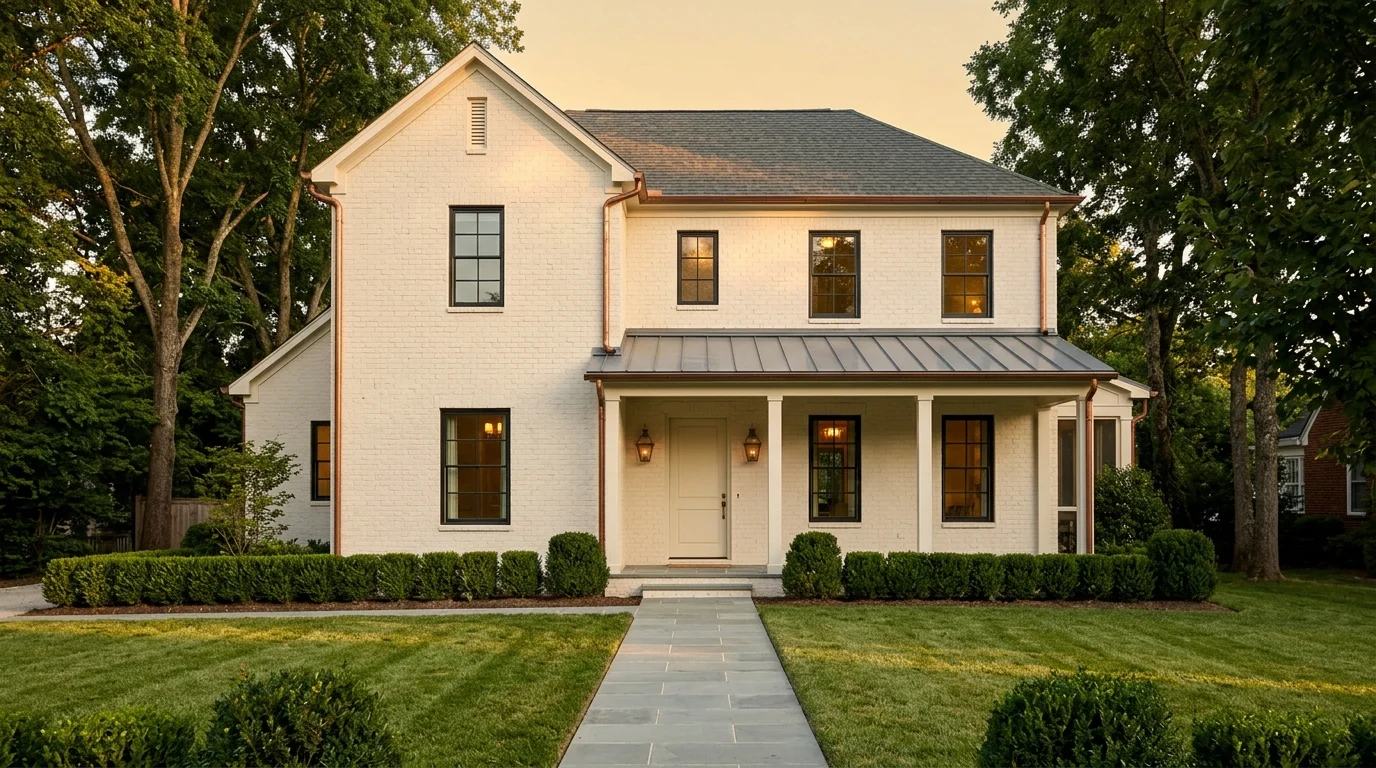
Selling a home in Nashville in 2026 comes down to four decisions that most sellers make with incomplete information: what to price against, what to fix before the photos, what the closing table actually takes out, and what you are legally required to put in writing. The market has shifted underneath all four. Greater Nashville REALTORS reported 15,636 active listings at the end of July 2026, a 9 percent increase over a year earlier, with six months of inventory and a median single-family price of $520,000. A seller who prices off last spring’s story is pricing off a different market.
This guide covers the mechanics, with the source for every number attached. It is written for the person who wants to understand the transaction rather than be walked through it, and it deliberately answers the questions that most seller pages skip: how the 2025 reappraisal should and should not affect your list price, who Tennessee law actually charges for the transfer tax, what a known sinkhole obligates you to say, why your short-term rental permit does not go with the house, and when the lot underneath your home is worth more than the home on it.
Where the Middle Tennessee market actually stands
Greater Nashville REALTORS publishes monthly figures for nine Middle Tennessee counties: Cheatham, Davidson, Dickson, Maury, Robertson, Rutherford, Sumner, Williamson and Wilson. The figures on this page come from its July 2026 release, published August 7, 2026. The association publishes a new release each month at greaternashvillerealtors.org, so check there for the latest month.
The headline number hides the part that matters to a seller, which is that the market split by price point. In the same July release, closings on homes priced above $800,000 rose 8 percent year over year with prices up 7 percent, while condominium closings fell 17 percent and the condo median slipped 2 percent to $334,900. Greater Nashville REALTORS’ own president described the summer as a tale of two markets. If you are selling a $1.5 million house in Green Hills and reading a headline written about the entry-level condo segment, the headline is not about you.
2026 month by month, nine counties
| Month | Closings | Median single-family | Median condo | Active listings | Avg days on market |
|---|---|---|---|---|---|
| January 2026 | 1,825 | $485,598 | $350,000 | 11,795 | 65 |
| February 2026 | 2,133 | $499,900 | $338,500 | 12,315 | 72 |
| March 2026 | 2,752 | $491,525 | $349,990 | 13,694 | 62 |
| April 2026 | 3,100 | $503,340 | $345,000 | 14,677 | 57 |
| May 2026 | 3,370 | $525,000 | $339,900 | 15,294 | 56 |
| June 2026 | 3,459 | $537,000 | $349,945 | 15,617 | 51 |
| July 2026 | 3,269 | $520,000 | $334,900 | 15,636 | 54 |
Read the inventory column rather than the price column. Active listings climbed every month of 2026 and finished July at six months of supply. Days on market improved every month from February through June and then turned. That combination, rising supply against a flat-to-softening median, is what makes list price the single highest-leverage decision in a 2026 Nashville sale.
One source, one period, every time
Greater Nashville REALTORS reports medians for nine counties. Realtracs publishes a separate summary for the fourteen-county Nashville metropolitan area. The two use different geographies and produce different numbers, and mixing them, or comparing one month from one against another month from the other, is the most common way a market claim becomes wrong. Every figure on this page is Greater Nashville REALTORS for the month named.
Price against the reappraisal, not against your tax bill
2025 was a reappraisal year in Davidson County. The Assessor of Property mailed new values on April 18, 2025, and reported a county-wide median value increase of 45 percent as of January 1, 2025, the first revaluation since 2021.
A great many Nashville homeowners read that 45 percent and concluded two things, one of which was wrong. The wrong one was that their taxes were about to rise 45 percent. Tennessee does not work that way. After a reappraisal, local government is required to reset the rate so that the same properties produce the same revenue as before, excluding new construction. That reset rate is called the certified tax rate. Metro’s own budget documents state it plainly: the 2025 reappraisal produced a combined revenue-neutral rate of $2.222 per $100 of assessed value, which the FY2026 budget then increased by $0.592 to a final combined rate of $2.814. That $2.814 combined Urban Services District rate, made up of a $2.782 General Services District levy plus a $0.032 Urban Services District levy, was re-adopted unchanged for tax year 2026 by ordinance BL2026-1378 on June 16, 2026.
Residential property in Tennessee is assessed at 25 percent of appraised value. The Assessor’s own worked example: a $400,000 appraisal produces $100,000 in assessed value, and $100,000 multiplied by 0.02814 is $2,814 in annual tax.
What this means when you set a list price
- Your new appraised value is a data point about your property relative to the county, not a list price. Half of all Davidson properties moved less than the 45 percent county median and half moved more.
- Because Metro adopted a rate $0.592 above the certified rate, the county median is not the break-even point. In the Urban Services District the combined rate fell from $3.254 in tax year 2024 to $2.814 in tax years 2025 and 2026, so a bill fell only where the value rose by less than about 16 percent, and a property that rose by the 45 percent median saw its bill rise by roughly a quarter.
- Buyers in 2026 underwrite the tax line. A well-prepared listing states the current tax year rate and jurisdiction rather than leaving a buyer to guess from a stale figure.
- Never quote a rate without its tax year and its jurisdiction. Williamson County’s county levy outside the Franklin Special School District, for example, fell from $1.88 in tax year 2024 to $1.30 in tax year 2025 and stayed at $1.30 for tax year 2026, with city rates added on top. Those are different numbers for different places, and a 2024 rate presented as current is simply wrong.
What it actually costs to close a sale in Tennessee
Two of these line items are widely misstated in Nashville seller content, so they are worth getting exactly right.
| Line item | Rate or basis | Who the law charges |
|---|---|---|
| Realty transfer tax | $0.37 per $100 of the greater of consideration paid or property value, which is $3.70 per $1,000 as the Davidson County Register of Deeds states it | The grantee, meaning the buyer, under Tenn. Code Ann. 67-4-409(a)(1)(F) and the Department of Revenue’s Recordation Tax Manual |
| Mortgage (indebtedness) tax | $0.115 per $100 of indebtedness, with the first $2,000 of debt exempt | Attaches to the new financing, so in a normal purchase it is a buyer-side cost |
| Recording fees, Davidson County | $5 per page for deeds and deeds of trust, $10 minimum, plus a $2 data processing fee | Allocated by contract |
| Brokerage compensation | Negotiable. Set in the listing agreement | Seller, per the agreement signed |
| Property tax proration | Your share of the tax year through closing | Seller, settled at closing |
| Payoff, title and settlement charges | Lender payoff, any title curative work, settlement fees | Varies by contract and closing agent |
The transfer tax correction
A large amount of Nashville seller content states that the seller customarily pays Tennessee’s transfer tax. The statute says otherwise. Tenn. Code Ann. 67-4-409(a)(1)(F) places the tax on the grantee or transferee of the interest in real estate, as shown on the instrument evidencing the transfer, and the Department of Revenue’s June 2026 Recordation Tax Manual states that the grantee or transferee is responsible for paying it. Parties can and do negotiate who reimburses whom in the purchase agreement, but start from the statute rather than from a blog post, and confirm the allocation in your contract in writing.
On brokerage compensation: it is negotiable, it belongs in the listing agreement in writing, and no honest Tennessee source can give you a standard rate, because there is not one. What you should ask for instead is specificity. What does the fee fund, what is the marketing plan in writing, how will buyer-side compensation be handled and disclosed, and what happens to the agreement if the property does not sell.
Earnest money and the 21-day rule
If a deal falls apart, earnest money becomes the point of friction. Under the Tennessee Real Estate Commission’s Rules of Conduct, chapter 1260-02, revised September 2025, a principal broker holding trust money may disburse it on a reasonable interpretation of the contract, on a separate written agreement signed by all interested parties, at closing, on rejection or withdrawal of an offer, on filing an interpleader, or on court order. Rule 1260-02-.09 also requires that, absent a compelling reason, earnest money is disbursed, interpleaded, or turned over to an attorney with instructions to interplead within 21 calendar days of receiving a written request for disbursement. Knowing that timeline before you need it is worth more than knowing it after.
Start with the number, not the narrative
A valuation grounded in your actual submarket, your actual reappraisal movement, and the current month’s inventory tells you whether to list now, prepare first, or wait.
Should you improve the house before you list it
In a market carrying six months of inventory, as Greater Nashville REALTORS reported for July, presentation stops being cosmetic and starts being competitive. The honest answer is that it depends on what the competing inventory in your specific price band looks like, and that is a question with a real answer rather than a matter of taste. The work most worth pricing out is the work that removes a buyer’s objection before the objection forms: paint, flooring, lighting, landscaping, and anything a buyer would otherwise write into an inspection response.
The capital question is usually the obstacle. Compass states that its Concierge program fronts sellers the cost of home improvement services with zero due until closing, across categories including staging, painting, flooring, landscaping, HVAC, roofing, and kitchen and bath work. Compass states that payment becomes due when the home sells, when the listing agreement is terminated by either party, when 12 months pass from the Concierge start date, or when Notable otherwise suspends the loan, whichever occurs first; that loans are made by Notable Finance, LLC; and that fees or interest may apply depending on the state.
How to decide
- Price the work against the specific listings a buyer will compare you to, not against a national return-on-investment table.
- Separate the work that changes the price from the work that changes the speed. They are different budgets and different decisions.
- Read the current program terms, including the repayment triggers and any fees, before you commit to a scope of work.
- If the property is likely a land sale, do none of it. See the section below.
Detail on the program as the team uses it is on the Compass Concierge page.
Buying before you sell
Selling into a market where active listings rose every month from January through July, and single-family homes averaged 54 days on market in July, changes the sequencing problem. The classic bind, needing the equity from the sale to buy the next house while not wanting to sell before you have somewhere to go, is what bridge financing exists to solve. The team’s page on bridge loan services covers how that works in practice.
The strategic point is simpler than the product. In a market where the buyer pool has more choice, a contingent offer is weaker than a clean one, and the cost of bridging can be smaller than the price concession a contingency invites. Model both. Then decide.
What Tennessee requires you to disclose
Tennessee’s Residential Property Disclosure Act, Tenn. Code Ann. 66-5-201 and following, requires the owner to furnish a purchaser one of two things: a residential property disclosure statement covering the condition of the property, including any material defects known to the owner, or, where the purchaser waives the disclosure, a disclaimer statement providing that the owner makes no representations as to condition. The statute is explicit that the owner is not required to undertake an independent investigation or inspection in order to make the disclosures.
Twelve categories of transfer are specifically excluded under 66-5-209, including transfers by court order, foreclosure sale, a trustee in bankruptcy, eminent domain, a deed in lieu of foreclosure, and transfers by a fiduciary administering an estate.
The sinkhole rule, effective July 1, 2024
Public Chapter 510 of 2024 amended Tenn. Code Ann. 66-5-212(c) to require that a seller, before entering into a contract with a buyer, disclose the presence of a known sinkhole on the property in the contract or in writing with acknowledgment of receipt, regardless of whether the sinkhole appears on the recorded plat map. Tennessee REALTORS amended forms RF201, RF203, RF204 and RF205 with a July 1, 2024 publication date to implement it. The U.S. Geological Survey lists Tennessee among the states where sinkholes tend to cause the most damage, which makes this a live issue here rather than a theoretical one.
Agency status is a separate disclosure. Tenn. Code Ann. 62-13-405 requires a licensee assisting an unrepresented buyer or seller to verbally disclose their facilitator, agent, subagent or designated agent status before any real estate services are provided, and to confirm it in writing. Under 62-13-403 a licensee owes duties to all parties to the transaction, including diligent exercise of reasonable skill and care, disclosure of adverse facts of which the licensee has actual notice or knowledge, and honesty and good faith.
When your lot is worth more than your house
In parts of Davidson County, the strongest bidder for a property can be a builder rather than a family, and that changes the entire preparation strategy: if the buyer intends to remove the structure, then paint, staging and a kitchen refresh are money set on fire.
Two things determine whether you are in that conversation. The first is what the parcel permits, which is a zoning and district question rather than a market question. The second is what a builder can realize from it, which is a function of the finished product the district allows and the price that product carries in that submarket.
Check the parcel, not the neighborhood
Zoning, overlay districts, horizontal property regime eligibility, lot size and flood mapping vary lot by lot, and a statement about a district is not a statement about your address. Verify a specific parcel through the Nashville Parcel Viewer and, for flood questions, the FEMA Map Service Center together with Metro’s flood tools. Metro Water Services is explicit that properties outside the special flood hazard area are not guaranteed to be free of flooding, so no one should tell you a property does not flood.
If you are selling acreage: settle greenbelt before you sign
Tennessee’s Agricultural, Forest and Open Space Land Act, codified at Tenn. Code Ann. 67-5-1001 through 1050, values enrolled land at its current use rather than its highest and best use. Agricultural land must be a tract of at least 15 acres, or two noncontiguous tracts of at least 15 and 10 acres; forest land must be at least 15 acres; open space land must be at least 3 acres. Applications are filed with the county assessor by March 15.
When enrolled land is disqualified, which a sale to a developer will do, rollback taxes recapture the tax savings for the preceding three years for agricultural and forest land and five years for open space land. The Comptroller’s Greenbelt Handbook is careful about the framing: rollback is a recapture of taxes saved, not a penalty. It becomes a first lien on the disqualified land, becomes delinquent March 1 following the year notice is given, and can be appealed only to the State Board of Equalization. On an estate or farm parcel in Williamson, Wilson or Maury County, that is a number that belongs in the negotiation from the first conversation rather than at the closing table.
Selling a home with a short-term rental permit attached
This is where Nashville sellers most often carry an expensive misunderstanding, and it cuts against the seller’s interest, so it is worth stating flatly.
The permit does not convey
Metro Code 6.28.030 provides that a short-term rental permit expires 365 days after issuance, that it cannot be transferred to another person, entity or address, and that on a change of ownership the new owner must apply under the rules then in effect. Separately, the grandfathering protection in the Tennessee Short-Term Rental Unit Act, Tenn. Code Ann. 13-7-601 through 13-7-606, preserves a prior use under the law in effect when the use began only until the property is sold or transferred, ceases to be used as a short-term rental for 30 continuous months, or has been in violation of a generally applicable local law three or more separate times. A sale ends it.
The practical consequences for a seller are specific. Marketing a property on the strength of rental income the buyer may not be able to reproduce invites a broken contract at best. Metro’s own permit-types page states that new non-owner-occupied permits are not issued in AR2A, R, RS or RM zoned properties, and that existing non-owner-occupied permits in those districts may renew but are non-transferable on sale. Condominium and homeowners association documents can restrict short-term rental use independently of Metro, and Tenn. Code Ann. 13-7-605 preserves their right to do so. Surrounding jurisdictions differ sharply: Belle Meade prohibits short-term rental use outright under its zoning code, and Mt. Juliet permits it only in the RM-16 district.
The right way to handle this is to present what is verifiable, point the buyer to Metro Codes and the Metro Short Term Rental Property Eligibility Viewer for a determination on that specific parcel, and let the buyer confirm eligibility themselves. Nobody selling a house should be issuing zoning opinions, and a buyer relying on one has a claim if it turns out wrong. The permit rules themselves are set out in full in Nashville Short-Term Rental Rules and Investment Guide 2026, and the team’s investor division page covers the buy side of the same question.
Selling discreetly
Not every seller wants a public launch. Some are selling an estate, some have a professional or personal reason for privacy, and some simply want to test price before the market clock starts running on a public listing.
Compass offers Private Exclusives, which allow a property to be shared privately with agents inside the network before any broader launch. Used well, that is a strategy question rather than a marketing default: it suits a property where the buyer pool is small and identifiable, where the seller’s timeline is flexible, or where discretion has independent value. It suits a broad-market property far less, because exposure is what produces competition and competition is what produces price.
The decision worth making deliberately is the sequencing: a property that has already been marketed publicly cannot return to being unseen, so that conversation belongs at the start, not after thirty days.
Frequently asked questions
Not by itself, but the rate Metro adopted did raise many bills. Tennessee requires local government to calculate a certified tax rate after a reappraisal, the rate that would produce the same revenue from the same properties. Metro reports that the 2025 reappraisal produced a revenue-neutral combined rate of $2.222 per $100 of assessed value, and that the FY2026 budget then set the rate $0.592 higher, at $2.814, the rate re-adopted for tax year 2026. The Assessor reported a county-wide median value increase of 45 percent as of January 1, 2025. Because the Urban Services District combined rate was $3.254 in tax year 2024, a property there saw its bill fall only if its value rose by less than about 16 percent, and a property that rose by the 45 percent median saw a higher bill.
Tennessee imposes a realty transfer tax of $0.37 per $100 of the greater of consideration paid or property value. Tenn. Code Ann. 67-4-409(a)(1)(F) places responsibility for paying it on the grantee, meaning the buyer, and the Department of Revenue’s Recordation Tax Manual states the same. Who reimburses whom can be addressed in the purchase contract, but the statutory responsibility sits with the buyer.
Under the Tennessee Residential Property Disclosure Act, Tenn. Code Ann. 66-5-201 and following, the owner must furnish either a residential property disclosure statement covering the condition of the property including known material defects, or, where the purchaser waives disclosure, a disclaimer statement. The owner is not required to conduct an independent inspection to make those disclosures. Twelve categories of transfer are excluded under 66-5-209. Since Public Chapter 510 took effect on July 1, 2024, a seller must also disclose a known sinkhole in writing before entering into a contract.
No. Metro Code 6.28.030 states a short-term rental permit cannot be transferred to another person, entity or address, and that on a change of ownership the new owner must apply under the rules in effect at that time. Separately, the grandfathered protection in the Tennessee Short-Term Rental Unit Act, Tenn. Code Ann. 13-7-601 through 13-7-606, ends when the property is sold or transferred. A buyer should confirm current eligibility for that specific parcel with Metro Codes before relying on rental income.
Greater Nashville REALTORS reported that the average number of days on market for a single-family home in July 2026 was 54 days, across its nine-county reporting area. The same release reported 15,636 active listings at the end of July, a 9 percent increase over a year earlier, and six months of available inventory.
Commission is negotiable and is set in the listing agreement between the seller and the brokerage. There is no standard or required rate in Tennessee, and any figure quoted as market-wide should be treated with caution. Ask for the compensation terms, the marketing the fee funds, and how buyer-side compensation will be handled, all in writing, before signing.
Compass states that sellers are fronted the cost of home improvement services with zero due until closing, covering staging, painting, flooring, landscaping and other categories. Compass states that payment becomes due when the home sells, when the listing agreement is terminated by either party, when 12 months pass from the Concierge start date, or when Notable otherwise suspends the loan, whichever occurs first, that loans are made by Notable Finance, LLC, and that fees or interest may apply depending on the state. Review the current program terms and your own agreement before relying on any of it.
Land enrolled in Tennessee’s greenbelt program is assessed at current use rather than highest and best use. When land is disqualified, rollback taxes recapture the tax savings for the preceding three years for agricultural and forest land, and five years for open space land. The Comptroller describes rollback as a recapture of taxes saved rather than a penalty. It becomes a first lien on the disqualified land, and it is a real number to settle before a contract is written on a farm or estate parcel.
Related resources
Talk to the team about selling your home
Whether you are twelve months out or ready to launch, the first conversation is about your specific property, your submarket, and your timing. No obligation, and no pressure to list before it makes sense for you.
Sources
- Greater Nashville REALTORS, July 2026 housing report (released August 7, 2026) and Monthly Area Home Sales data, greaternashvillerealtors.org
- Metropolitan Nashville Assessor of Property, 2025 Reappraisal and Tax Rates and Calculator, padctn.org and nashville.gov
- Metro Nashville FY2026 Operating Budget Book and FY2027 Recommended Budget Book, nashville.gov
- Metro Nashville ordinance BL2026-1378, adopted June 16, 2026
- Tennessee Department of Revenue, Realty Transfer (Recordation) Tax Manual, June 2026, and Recordation Taxes due date and rate page, tn.gov/revenue
- Tenn. Code Ann. 67-4-409 (realty transfer and mortgage tax); 66-5-201 through 66-5-212 (Residential Property Disclosure Act); 62-13-403 and 62-13-405 (agency duties and disclosure); 67-5-1001 through 67-5-1050 (greenbelt); 13-7-601 through 13-7-606 (Short-Term Rental Unit Act)
- Public Chapter 510 (2024), known sinkhole disclosure, effective July 1, 2024, publications.tnsosfiles.com
- Tennessee Real Estate Commission Rules of Conduct, chapter 1260-02, September 2025 revision
- Davidson County Register of Deeds, filing fees, nashville.gov
- Metro Nashville Code 6.28.030 and Metro Codes short-term rental permit types, nashville.gov and Municode
- Tennessee Comptroller of the Treasury, Greenbelt Handbook, revised May 2025
- Compass Concierge program terms, compass.com/concierge
- Compass Private Exclusives, compass.com/private-exclusives
- Tennessee Comptroller of the Treasury, property tax rates for tax years 2024 and 2025, and Williamson County FY2027 budget
- Greater Nashville REALTORS President’s column on July 2026 home sales, August 2026
- Tennessee REALTORS, mid-year forms update, June 26, 2024, tnrealtors.com
- Metro Water Services, Know Your Flood Hazard, and Nashville Parcel Viewer, nashville.gov
- City of Belle Meade Zoning Code, Title 14 (Ord. 2024-14), and City of Mt. Juliet Zoning Ordinance 5-101.3
- U.S. Geological Survey, Sinkholes, usgs.gov
Figures are current as of the dates stated. Tax rates, statutes and municipal codes change. This guide is general information about the sale process in Tennessee and is not legal, tax or zoning advice. Confirm anything specific to your property or your circumstances with the appropriate professional and with Metro Codes or your county’s offices.