

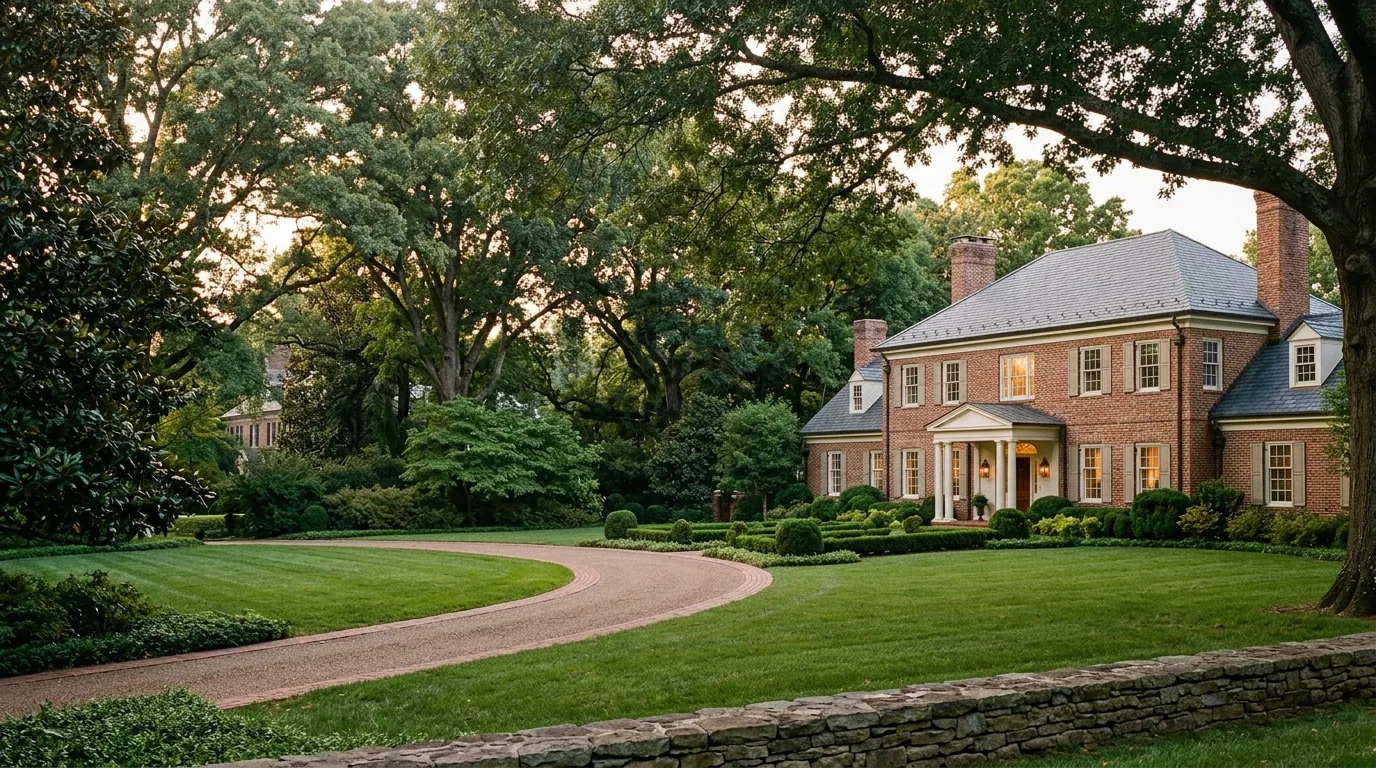
A Belle Meade estate and a Green Hills estate can look alike from the street and still answer to different governments. Belle Meade is a separately incorporated city inside Davidson County that writes its own zoning code, reviews its own teardowns, issues its own permits, levies its own property tax and holds its own place in the federal flood insurance program, while Green Hills has no city government and is planned, zoned and permitted by Metro Nashville. That split decides what a lot allows, who approves a demolition, what the tax line is and which flood rules apply, and it sits underneath every price in both places.
Start with the government, not the neighborhood
The City of Belle Meade has a City Manager-Commissioner government. Its zoning code, Title 14, was repealed and replaced by Ordinance 2024-14 on September 18, 2024. The city issues its own permits, reviews teardowns through a Historic Zoning Commission, runs its own stormwater program and is its own National Flood Insurance Program community, number 470408, separate from Metro’s 470040.
Green Hills is not a city. Metro plans it through the Green Hills-Midtown Community Plan (NashvilleNext Volume III, adopted June 22, 2015, amended August 24, 2017), whose plan area is far larger than Green Hills: about 40 square miles bounded by the City of Belle Meade and the CSX railroad on the west, I-40 and I-65 on the north, I-65 on the east and Williamson County on the south. Forest Hills and Oak Hill lie entirely inside that area but are separate cities with their own planning and zoning, so an estate described loosely as Green Hills can sit in a third or fourth jurisdiction. Their rules are in the estate and penthouse guide.
This guide draws no boundary around Green Hills. For a Metro parcel, the Nashville Parcel Viewer shows zoning, overlays, the tax district and permits; in Belle Meade, the city’s Zoning page publishes the zoning map and city staff confirm a lot’s district. The table compares rulebooks, not places.
| Rule | City of Belle Meade | Metro Nashville, including Green Hills |
|---|---|---|
| Zoning code | Title 14 (Ordinance 2024-14); five districts | Metro’s code; RS districts single-family only, R districts one- and two-family |
| Design review | Certificate of appropriateness for demolition, additions and new houses, citywide | Where an overlay applies: a site plan or preservation permit |
| Trees | Permit with any permitted construction, demolition or land disturbance | Not stated here for a teardown; ask Metro about the lot |
| Short-term rentals | Prohibited; no variance | No new non-owner-occupied permits in AR2a, R, RS or RM |
| Tax per $100 of assessed value | $3.0831 combined, tax year 2025 | $2.814 (Urban Services District) or $2.782 (General Services District only), tax years 2025 and 2026 |
Belle Meade lots: five districts and the envelope each allows
Belle Meade has five districts: Estates A, Estates B, Residence A, Residence B and Residence C. The code describes Estates A as preserving large-estate character with greater setbacks and a more rural appearance, and Residence C as a more urban pattern on some of the city’s smallest lots. There is no R-1 district and no one-acre minimum, though both labels circulate.
| District | Minimum lot | Minimum width | Height at front building line | Footprint cap | Floor area ratio |
|---|---|---|---|---|---|
| Estates A | 200,000 sq ft | 125 ft | 40 ft | 8 percent | 0.20 |
| Estates B | 75,000 sq ft | 125 ft | 40 ft | 12 percent | 0.20 |
| Residence A | 70,000 sq ft | 125 ft | 40 ft (35 ft on lots of 40,000 sq ft or less) | 12 percent | 0.20 |
| Residence B | 40,000 sq ft | 125 ft | 40 ft (35 ft on lots of 40,000 sq ft or less) | 12 percent | 0.20 |
| Residence C | 20,000 sq ft | 120 ft | 30 ft | 12 percent | 0.225 |
The 0.225 ratio applies to any lot of 40,000 square feet or less, and the footprint cap counts the house above natural grade plus all garages and any pool house. Each side yard must be at least 20 percent of the lot width at the front setback line, and both together at least 50 percent. A dwelling’s sides and rear may reach 50 feet in height (40 in Residence C). No dwelling may be under 2,000 square feet, and on a lot under 10 acres none may exceed 20,000. Confirm front-yard setbacks with the city for the specific lot.
Illustrative arithmetic
- An Estates A lot of exactly 200,000 square feet (about 4.6 acres): a 16,000-square-foot combined footprint, and a 0.20 ratio worth 40,000 square feet of floor area, though the house itself stops at 20,000 because the lot is under 10 acres.
- A lot 125 feet wide at the front setback line: side yards of at least 25 feet each and 62.5 feet together, leaving no more than 62.5 feet of house width there.
Arithmetic, not a plan; the code’s definitions govern. For a seller, the envelope is the land’s value to a builder.
Tearing down and building new in Belle Meade
Building a new principal building, adding to one or demolishing one requires a certificate of appropriateness under the Citywide Conservation Overlay Design Guidelines, in addition to the building permit. The owner first meets the planning director. The Historic Zoning Commission acts within 30 days of accepting a complete application, and a demolition application needs photographs, a statement of reasons and the proposed use of the site. The director may approve administratively the demolition of accessory structures, of a major life-safety hazard or of a primary building under fifty years old.
Permits for new residences, additions, demolitions, pools, pool houses, fences and driveways go through the city’s CivicGov portal, to an applicant with a state contractor’s license and workers’ compensation insurance or to the homeowner. The Building and Zoning Department issues land disturbance permits for private lots.
The fence comes before the permit
Since March 15, 2026, a permit for demolition or new construction requires a locking security fence around the whole property, or around the construction area on sites over 2 acres: 6 to 8 feet high, green, opaque and free of advertising, with vehicles and materials behind it. City staff must verify it before the permit issues (section 12-103, amended by Ordinance 2025-14 on February 18, 2026).
Trees shape the design
Chapter 12-5 of the municipal code (Ordinance 2019-11, May 2020) requires a tree removal permit whenever construction, demolition or permitted land disturbance is proposed, with a stamped certified-arborist report and a site plan showing every tree’s caliper. The city applies the ordinance to homeowners too: a portal application comes before any tree is removed.
On a permitted project, removed trees of 4 to 15 inches in diameter at breast height are replaced two for one with trees of at least 3-inch caliper, and trees of 16 to 30 inches four for one (removal outside a project follows section 12-512). A tree over 30 inches is a monarch tree and may not be removed except as a clear threat to public safety, and during construction no lot may be clear-cut outside the approved building area. A monarch tree where a buyer pictures the new house is a fixed point in the design, so the arborist survey belongs before the price is agreed.
Building in Green Hills under Metro’s rules
Green Hills’ reference document is Metro’s community plan, which is policy, not zoning. It applies Neighborhood Maintenance policy to established residential neighborhoods, to maintain and enhance them, and points additional development to Neighborhood Evolving, Center and Corridor areas. It notes that many suburban neighborhoods with large residential lots are in Green Hills. The policies guide zoning and development decisions; what a lot is zoned today is on the Parcel Viewer.
Metro’s RS districts (RS80 to RS3.75) are single-family only, and its R districts (R80 to R6) allow one- and two-family dwellings; a two-family dwelling may be permitted on any legally created R lot that meets the district minimum. Minimum lot areas run from 80,000 square feet down to 3,750. The district varies parcel by parcel, and this guide makes no statement about any street.
Where a contextual overlay applies, it sets standards across a block face without changing the base zoning: height is capped at the lesser of 35 feet or 125 percent of the abutting houses’ average, the street setback is the abutting lots’ average, and coverage is capped at 150 percent of their average, with a site plan reviewed at building permit. A neighborhood conservation overlay requires a preservation permit for new construction, additions, demolition and relocation, not for repairs or paint.
A Metro grading permit is required for land disturbance over 10,000 square feet, and all development in a Special Flood Hazard Area needs local permits.
What does the lot allow, and what is it worth?
An estate valuation starts with the governing jurisdiction, the district envelope and the sales that genuinely compare, and ends with a price range you can test.
Property taxes, with the year and the jurisdiction on every rate
Tennessee assesses residential property at 25 percent of appraised value; the bill is the assessed value divided by 100, times the rate. For tax year 2025 a Belle Meade parcel pays the city’s $0.3011 plus Metro’s General Services District rate of $2.782, a combined $3.0831 in the Tennessee Comptroller’s 2025 table, and not the Urban Services District rate. In Metro, the General Services District rate is $2.782 and the Urban Services District combined rate $2.814 for tax years 2025 and 2026, re-adopted by BL2026-1378 on June 16, 2026; the Parcel Viewer’s tax district field shows which a Green Hills parcel pays. No Belle Meade rate for tax year 2026 is stated here, so confirm it with the city.
| Appraised value | Assessed at 25 percent | Belle Meade, tax year 2025 ($3.0831) | Metro Urban Services District, tax years 2025 and 2026 ($2.814) | Metro General Services District only, tax years 2025 and 2026 ($2.782) |
|---|---|---|---|---|
| $3,000,000 | $750,000 | $23,123.25 ($2,258.25 city plus $20,865 Metro) | $21,105 | $20,865 |
| $5,000,000 | $1,250,000 | $38,538.75 ($3,763.75 city plus $34,775 Metro) | $35,175 | $34,775 |
The $3,000,000 Belle Meade line matches the worked example in the city’s 2025 bill instructions. All figures are illustrative arithmetic on the Assessor’s appraised value, which is not a contract price.
Why the county median is not the break-even point
The Assessor reported a county-wide median value increase of 45 percent as of January 1, 2025. Metro reports that the reappraisal produced a revenue-neutral combined rate of $2.222 and that the FY2026 budget set the rate $0.592 higher, at $2.814, so the adopted rate was not revenue-neutral and did not keep bills flat. Against tax year 2024 rates:
- Urban Services District, $3.254 to $2.814: a bill fell only where the value rose by less than about 16 percent, and a value that rose by the 45 percent median produced a bill about 25 percent higher.
- General Services District only, $2.922 to $2.782: a bill fell only where the value rose by less than about 5 percent.
- Belle Meade, $3.422 ($2.922 plus the city’s $0.50) to $3.0831: a bill fell only where the value rose by less than about 11 percent, and a value that rose by the 45 percent county-wide median would have produced a bill about 31 percent higher.
The full mechanics are in the 2025 reappraisal explainer. The realty transfer tax is separate: $0.37 per $100 of the greater of the price or the value, $18,500 on a $5,000,000 transfer, placed on the grantee, the buyer, by Tenn. Code Ann. 67-4-409(a)(1)(F). Seller costs are in the complete 2026 guide to selling a home in Nashville.
Flood and stormwater: two programs, one method
Belle Meade’s floodplain zoning ordinance (Ordinance 2003-5, amended by Ordinance 2004-7) keeps the city in the National Flood Insurance Program and requires the lowest floor of a new or substantially improved residence in an AE zone, basement included, to sit at least 2 feet above base flood elevation. Metro requires 4 feet above the 1-percent-annual-chance elevation, offsets fill with equal cut and prohibits floodway development with few exceptions. The same zone carries different building consequences on each side of the city line.
FEMA’s Community Status Book lists Belle Meade’s current effective map date as April 5, 2017 and Metro’s as June 20, 2024; a map date identifies the map in effect, not the risk at an address.
Metro Water Services states that a structure in the Special Flood Hazard Area has a 26 percent chance of flooding over a 30-year mortgage and that property outside it is not guaranteed to be free of flooding, so no one should present an estate in either place as free of flood risk. Start with msc.fema.gov, FEMA’s official public source. Metro Development Services (615-862-7225) provides the FIRM zone, panel, base flood elevation, floodway status and elevation certificates for Metro parcels; for a Belle Meade parcel, confirm with the city too. The method is in how to read the flood map for one address.
Short-term rentals and an estate’s value
Belle Meade prohibits short-term rental, meaning under 30 continuous days, of any dwelling, accessory building or pool house, with no variance available. A prior use survives only as the Tennessee Short-Term Rental Unit Act (Tenn. Code Ann. 13-7-601 to 13-7-606) allows, and that protection ends on a sale or transfer, so a buyer does not inherit it. Metro issues no new non-owner-occupied permits in AR2a, R, RS or RM zones, and existing ones do not transfer on sale. Rental income has no place in a Belle Meade price; in Green Hills, check the address in Metro’s Short Term Rental Property Eligibility Viewer first.
How estates here are priced
What the regional figures say
- August 2026 (Greater Nashville REALTORS, released September 8, 2026, nine counties): 2,928 closings, down 4 percent from August 2025; a median single-family price of $515,725; 5.8 months of inventory.
- The August release has no band above $800,000. In July 2026, the latest reading, closings above $800,000 rose 8 percent year over year and prices 7 percent, across the same nine counties. The band is broad and does not measure the estate tier.
- Davidson County only, calendar 2025: 1,419 sales at $1 million or more, 13 percent of transactions, per Greater Nashville REALTORS president Jack Gaughan’s August 23, 2026 column. It does not combine with the monthly nine-county data.
No price series is quoted here for either place. An estate price is built from three readings: what the land allows (the envelope, plus the review path and any monarch trees in Belle Meade, or the Metro district and overlay in Green Hills), what the house is worth to a buyer who keeps it, and what it costs to hold (the tax line for the right jurisdiction and year, and flood insurance where the map calls for it). Bracket the property between the closest sales above and below, adjust older sales to the current market, and price inside that range on purpose. The 2025 reappraisal value is a figure for taxation, not a list price.
Marketing an estate, and keeping it discreet
Some owners need to control exposure, whether to settle an estate, protect privacy or test price before a public clock starts. Compass describes a Private Exclusive as a property shared with agents in its network of brokerages and their buyers, with no public days on market or price-drop history, photos and floorplans kept inside the network and private showings. Its three phases are a Private Exclusive phase to validate pricing, a Coming Soon phase to expand reach, then public websites.
It is a trade-off that does not assure privacy, price or speed. Exposure is what produces competing offers, and a publicly marketed property cannot return to being unseen, so set the sequence and the trigger for going public in writing at the start. Any buyer qualification should be financial only, proof of funds, asked the same way of every buyer. See the team’s Luxury Portfolio and Erin Krueger’s profile.
Verifying one property, step by step
- Establish the government (Belle Meade, Metro, Forest Hills or Oak Hill) from the Parcel Viewer’s tax district or the city’s zoning map.
- Read the district and any overlay, from the city’s map in Belle Meade or the Parcel Viewer in Metro.
- Draw the envelope: footprint, floor area, height and side yards, with the front setback from city staff in Belle Meade.
- Map the review path: a certificate of appropriateness in Belle Meade; any contextual or conservation overlay in Metro.
- Survey the trees before design work, locating anything over 30 inches in Belle Meade.
- Read the flood map, confirm it with Metro or the city, and collect any elevation certificate.
- Compute the tax line and label it with the appraised value, the tax year and the jurisdiction.
- Trace permits to the government that issued them, and budget the transfer tax, which the buyer owes.
The team can walk through these steps with you for a specific Belle Meade or Green Hills property.
Frequently asked questions
No. The City of Belle Meade applies its own zoning code, replaced by Ordinance 2024-14 on September 18, 2024, along with its own Historic Zoning Commission review of teardowns and new houses, its own building permits and a short-term rental ban. For tax year 2025 a Belle Meade parcel pays the city’s $0.3011 per $100 of assessed value plus Metro’s General Services District rate of $2.782, a combined $3.0831. FEMA lists the city as its own flood insurance community.
No. Green Hills has no city government. It is part of Metro Nashville, planned through the Green Hills-Midtown Community Plan, so Metro handles its zoning, permits and flood mapping. Two separate cities, Forest Hills and Oak Hill, sit inside that plan area with their own planning and zoning, so check a parcel’s jurisdiction and tax district in the Nashville Parcel Viewer before relying on any rule.
About $38,539 a year at tax year 2025 rates. Residential property is assessed at 25 percent of appraised value, so a $5,000,000 appraisal is $1,250,000 assessed. The city rate of $0.3011 per $100 gives $3,763.75, and Metro’s General Services District rate of $2.782 gives $34,775, a combined $38,538.75. This is illustrative arithmetic on the appraised value; confirm the current year’s city rate before estimating a bill.
It depends on the district. The footprint above natural grade, with garages and any pool house, may cover 8 percent of the lot in Estates A and 12 percent elsewhere. The floor area ratio is 0.20, or 0.225 in Residence C and on lots of 40,000 square feet or less. No dwelling may be under 2,000 square feet, and on a lot under 10 acres none may exceed 20,000. Height at the front building line is capped at 40 feet (35 feet on Residence A and B lots of 40,000 square feet or less) and 30 feet in Residence C.
A certificate of appropriateness under the city’s conservation overlay, in addition to the demolition permit, and the application needs photographs, reasons and the proposed use of the site. For a primary building under fifty years old the planning director may approve it administratively, without Historic Zoning Commission review; otherwise the commission acts within 30 days of accepting a complete application. A tree removal permit is also required, and a locking security fence must be verified by city staff before the permit issues.
Only with a permit. The city requires a tree removal application through its portal before any tree is removed, including by a homeowner. On a project that needs a city permit, trees of 4 to 15 inches in diameter at breast height are replaced two for one with trees of at least 3-inch caliper, trees of 16 to 30 inches four for one, and a tree over 30 inches is a monarch tree that may be removed only as a clear threat to public safety. Removal outside a permitted project follows section 12-512 instead; confirm it with the city.
Start with FEMA’s Flood Map Service Center, msc.fema.gov, then confirm with the right government. Belle Meade is its own flood insurance community with its own floodplain ordinance; a Green Hills parcel falls under Metro, whose Development Services office provides the FIRM zone, panel, base flood elevation, floodway status and elevation certificates on request. No map result rules out flooding: Metro notes that property outside the Special Flood Hazard Area is not guaranteed to be free of it.
It can be marketed privately first. Compass describes a Private Exclusive as a listing shared with agents in its network of brokerages and their buyers, with no public days on market or price-drop history, before a Coming Soon phase and then public websites. It does not assure privacy, price or speed, and exposure is what produces competing offers, so settle the sequence and the trigger for going public in writing before launch.
Related resources
Talk to the team about a Belle Meade or Green Hills estate
The first conversation is about one property: its jurisdiction, what its lot allows, its tax line and whether a private-first launch fits. No obligation, and no pressure to list before it makes sense for you.
Sources
- City of Belle Meade Municipal Code: Title 14 (Ord. 2024-14); section 12-103 (Ord. 2025-14); Chapters 12-4 (floodplain) and 12-5 (trees), bellemeade.municipalcodeonline.com
- City of Belle Meade: Building Permits, Zoning, Stormwater, Tree Ordinance and Commissioners pages, and 2025 property tax bill instructions, citybellemeade.org
- Metro Nashville Planning: Green Hills-Midtown Community Plan (NashvilleNext Volume III), Zoning Classifications and Contextual Overlays pages; Metro Historic Zoning Commission Handbook, nashville.gov
- Metro Code 17.12.020A, 17.16.030 and 17.36.450 to 17.36.500, Municode; Metro Codes short-term rental permit types; Nashville Parcel Viewer
- Tennessee Comptroller, property tax rates for tax years 2024 and 2025; Metro Assessor, 2025 Reappraisal; Metro FY2027 Recommended Budget Book; ordinance BL2026-1378
- Tenn. Code Ann. 67-4-409 and 13-7-601 to 13-7-606
- FEMA Community Status Book (Tennessee) and Flood Map Service Center; Metro Water Services, Know Your Flood Hazard and Build Responsibly
- Greater Nashville REALTORS, August and July 2026 housing reports and President’s Perspective column of August 23, 2026, greaternashvillerealtors.org
- Compass Private Exclusives, compass.com/private-exclusives
Figures are current as of the dates stated. Tax rates, statutes, municipal codes and program terms change. This guide is general information about buying and selling estate property in Belle Meade and Green Hills and is not legal, tax, zoning or flood advice. Confirm anything specific to your property with the appropriate professional and with the City of Belle Meade, Metro Codes or your county’s offices.