

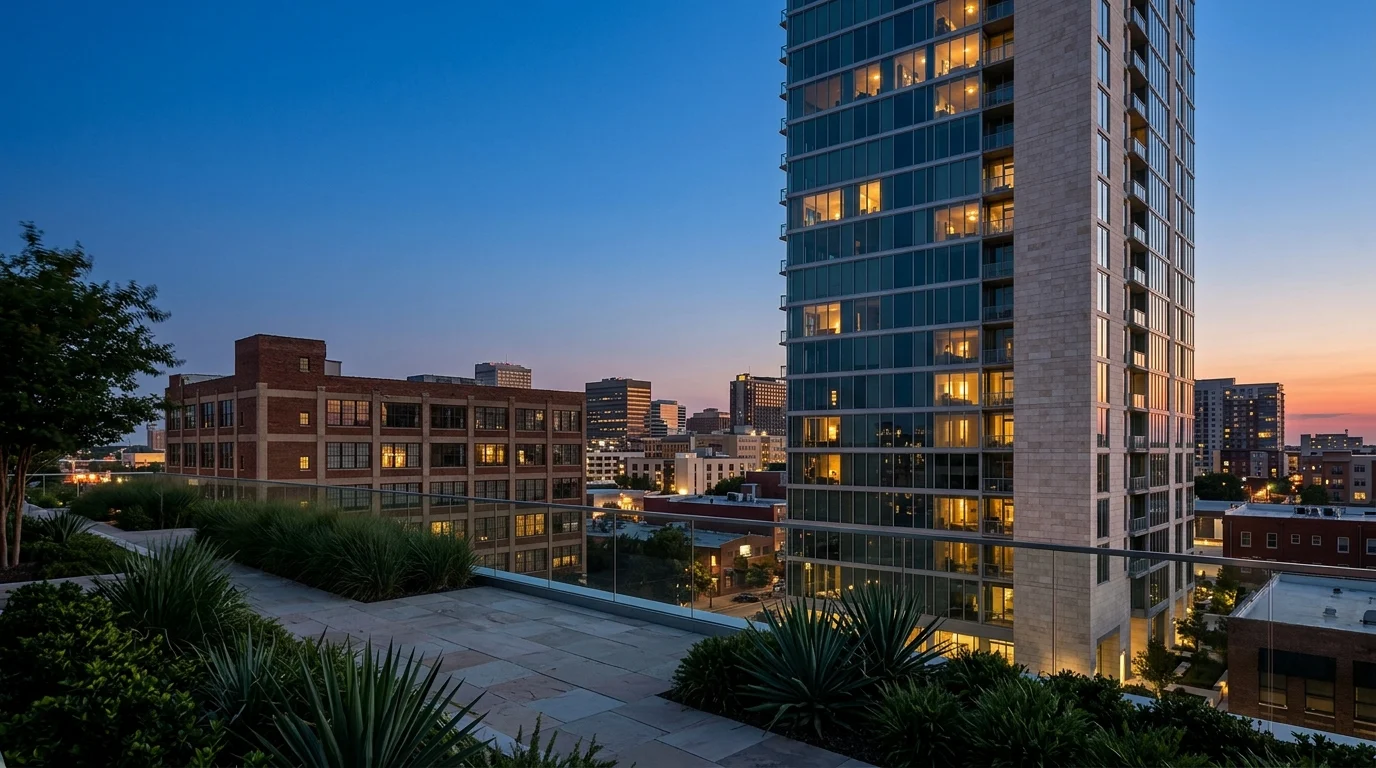
Buying or selling a condo in Nashville’s urban core in 2026 turns on three things a listing photo cannot show: what the building’s association is required to disclose, what the building’s own documents allow, and what the zoning on the lot next door permits. Downtown held 23,335 residents in 16,802 units at midyear 2026, according to the Nashville Downtown Partnership, with another 1,490 units under construction and 9,394 planned, so every condo sold here is priced against supply that is still being built.
This guide treats Downtown, The Gulch, Germantown and Midtown as separate submarkets with separate rulebooks. It does not rank buildings or quote unit sale prices, and building facts appear only where the building’s own site states them.
The urban core in numbers
The Nashville Downtown Partnership, created in 1994, publishes the figures below for downtown as it defines it. They come from its own reports, not from the Census.
The Partnership’s 2025 Annual Report counted 22,000 residents in 15,151 units, with 1,400 residential units delivered during 2025, and its 2025 Annual Residential Report put the downtown housing stock at 75 percent rental and 25 percent condominium. The Partnership’s 2026 Midyear Residential Update projects 28,921 downtown residents by 2030.
Two readings matter to a condo owner. Condominiums are the smaller share of downtown housing, so a buyer can also rent from a much larger apartment stock, and the case for owning has to be made on the unit and the building. And the pipeline has thinned: the 2025 Annual Report listed 2,975 units under construction, the 2026 midyear update 1,490. The planned figure is the one to watch when a site near your building files plans.
Which number describes your unit
The Partnership counts people and homes, not sales. Greater Nashville REALTORS reported a median condominium price of $334,900 for July 2026, but that median covers condominium closings across its nine-county area: Cheatham, Davidson, Dickson, Maury, Robertson, Rutherford, Sumner, Williamson and Wilson. It is context, not a comparable. The comparable for a tower unit is closed sales in its own building and its direct peers.
Four neighborhoods, four rulebooks
The urban core is not one market. These four areas sit under different zoning, different special districts and, in places, historic overlays. Metro Planning’s fourteen NashvilleNext community plans, two of them named Downtown and Green Hills-Midtown, are a sounder starting point than any marketing map.
Downtown
The Partnership’s 2024 Business Census defines its study area as every business inside the interstate loop and south of Jefferson Street. Most zoning here is the Downtown Code, covered below, whose subdistricts carry names buyers already use, such as Core, SoBro, Rutledge Hill and Rolling Mill Hill. Metro’s historic preservation overlay districts also include ones named Broadway, Downtown and Second Avenue, so a downtown location can carry an overlay in addition to the code. See the team’s Downtown Nashville page.
The Gulch
A railroad yard with roots before the Civil War, the Gulch declined after World War II and was transformed from the early 2000s into a mixed-use neighborhood, with MarketStreet Enterprises as lead developer. In January 2009 it earned LEED for Neighborhood Development Silver certification. The Downtown Code includes two subdistricts named Gulch North and Gulch South.
The Gulch also has its own Business Improvement District, formed in 2006 when residents, business and property owners voted to create it. The district covers all 91 acres of the Gulch, is funded by property-based assessments, is governed by a volunteer board elected by property owners, and is managed by the Nashville Downtown Partnership. Its current term runs from January 1, 2017 through December 31, 2026. Under Ordinance BL2025-846, enacted in July 2025, the Gulch district expires on that date and its area passes into a new Downtown Central Business Improvement District, so ask how the district assessment applies to a unit now and from January 1, 2027. See the team’s The Gulch page.
Germantown
Germantown was listed on the National Register of Historic Places in August 1979. Its Historic Preservation Zoning Overlay was applied by Ordinance BL2007-19 to 548 properties on 93.08 acres bounded by Rosa Parks Boulevard, Jefferson Street, Hume Street and 2nd Avenue North, effective June 2, 2008.
Germantown is not a Downtown Code subdistrict. For an owner, the overlay is a fact to confirm rather than assume: whether an address sits inside it is a question for the Nashville Parcel Viewer, and what the Metro Historic Zoning Commission’s guidelines review for that property is a question for Commission staff. See the team’s Germantown page.
Midtown
Midtown is not one of the Downtown Code’s named subdistricts, so check the zoning of record for a Midtown building in the Nashville Parcel Viewer. Midtown’s example is The Adelicia, an 18-story mixed-use tower with 186 condominiums between Music Row and the Vanderbilt campuses, whose site describes current listings as owner resales. In a resale-only building the competition is other owners, and the association’s history is the document a buyer actually reads. See the team’s Midtown page.
The towers, as their own sites describe them
Each fact below comes from the building’s or the developer’s own site. Where a site states no unit count, completion year or ownership structure, neither does this table.
| Building | Address or location, as stated | What its own site states |
|---|---|---|
| 505 Nashville | 505 Church Street, at Church Street and 5th Avenue | A 45-story tower whose site describes apartments, condominiums and penthouses. A Giarratana property |
| Alcove | 900 Church Street | A 34-story tower by Giarratana. Its site offers residences for lease, not for sale |
| Icon in the Gulch | 600 12th Avenue South | Twenty-two stories. All condos are individually and privately owned |
| The Adelicia | Midtown, between Music Row and the Vanderbilt campuses | An 18-story mixed-use tower containing 186 condominiums. Current listings are owner resales |
| Paramount | 1010 Church Street | Under construction. A 750-foot tower by Giarratana LLC, with residences planned on floors 41 through 60 and a Penthouse Collection on floors 57 through 60. Press coverage compiled on the developer’s press page reports 60 stories, 140 condos and a September 15, 2025 groundbreaking |
| Nashville Yards | A 19-acre mixed-use development by Southwest Value Partners | 673 residences across two towers, combining condominiums for sale and apartments for lease, within a development that also includes office, two hotels and a music venue |
Other condominium buildings in the core include Four Seasons Private Residences, The Broadwest, Twelve Twelve, Terrazzo, Viridian and Encore. This guide does not state their unit counts, heights or completion years. For any of them, the recorded declaration and the association’s resale information settle what a listing sheet leaves open.
Read a developer’s description as a developer’s description
Paramount’s story and condo counts are press-reported figures compiled by the developer, not Metro records, and the tower is still under construction. A floor count is a fact. A developer’s superlative is marketing, so none is repeated here.
The Downtown Code and what it means for new supply
The Downtown Code is Chapter 17.37 of the Metropolitan Zoning Code. It is a form-based code, regulating the shape and placement of buildings. Metro describes it as applying to much of the Downtown Community Plan area west of the river, and it also contains the East Bank and East Bend subdistricts across the river. It was adopted in 2010 as an attachment to Ordinance BL2009-586, adopted February 2, 2010, and has been amended repeatedly, including by BL2025-761 and BL2025-799, both adopted May 20, 2025, and by BL2026-1273, effective May 1, 2026.
The 2025 code named sixteen subdistricts: James Robertson, Core, Core Historic, Upper Broadway, 2nd and Broadway, River, SoBro, Lafayette, Rutledge Hill, Rolling Mill Hill, Rutledge River, Gulch North, Gulch South, Hope Gardens, Sulphur Dell and East Bank. BL2026-1273, effective May 1, 2026, added East Bend, on the East Bank between I-24, Korean Veterans Boulevard and the Cumberland River. Land uses are set by five use areas, Central, South, West, North and East, whose boundaries match subdistrict boundaries.
The Bonus Height Program
The voluntary Bonus Height Program lets a Downtown Code property earn additional height, up to the site’s Bonus Height Maximum, in exchange for specified public benefits, and the code cites LEED certification and public open space among the bonus rationales. A rewritten program took effect May 30, 2025 under BL2025-799 as phase one, and the 2025 code text anticipated a second phase adding an attainable housing bonus.
Three details matter to a neighbor. Transfer-eligible bonus height may be transferred once to a receiving site within the Downtown Code, so a site’s potential height can reflect benefits provided somewhere else. Bonus height may not be applied on top of a Historic Asset. And the code’s Baseline Requirements apply to new development of 50,000 gross square feet or more.
The practical reading: the height of the building next door is set by the code, the bonus program and any transferred height, not by the view a unit enjoys today. A surface lot across the street is a development site with a height envelope, and an informed buyer prices it that way.
Across the river
Metro describes the East Bank as a 550-acre area along the Cumberland River that includes 130 acres of Metro-owned land. The Imagine East Bank planning study, covering 338 acres of that area, was adopted by the Metro Planning Commission on October 6, 2022. In April 2024 Metro Council approved a Master Developer Agreement with The Fallon Company for the first 30 acres of Metro-owned land, an initial development area the mayor’s office put at 1,550 residential units. The Tennessee Titans state that the enclosed New Nissan Stadium on the East Bank opens in 2027. None of that is inventory a buyer can close on today. All of it is supply a buyer can see coming.
Check the parcel, not the skyline
Every statement in this section is about districts. For a specific site, including the one across the street, the Nashville Parcel Viewer shows the zoning of record. For flood mapping on a specific address, use the FEMA Map Service Center with Metro’s flood tools.
Start with your building, not the regional median
A condo valuation begins with closed sales in your own building and its peers, your association’s finances, and what is rising around you.
How condo ownership works in Tennessee
Tennessee has two condominium statutes in one chapter of its code. Part 1 of Title 66, Chapter 27, beginning at Tenn. Code Ann. 66-27-101, is the Horizontal Property Act. Parts 2 through 5 are the Tennessee Condominium Act of 2008, under 66-27-201. Under 66-27-202, the 2008 Act applies to condominiums created in Tennessee after January 1, 2009; specified sections reach older condominiums, but only for events after that date; and an older condominium may elect into the Act by amending and restating its master deed, bylaws and plat. The first question about any building is when its condominium was created and whether it has elected in.
The resale information the association must produce
Under 66-27-502, when a unit owner, a purchaser or a lender asks, the association must provide the information specified in 66-27-503 within ten business days. It may charge a reasonable fee, which can be assessed against the unit if unpaid. The requester is entitled to rely on the information unless it has actual knowledge to the contrary, and delivery may be electronic, including by email or website posting.
| What 66-27-503 covers | What to read it for |
|---|---|
| Recorded declaration, bylaws, charter and amendments, and the current rules | Leasing and short-term rental restrictions, and how the documents are amended |
| The latest balance sheet, income statement and approved budget, including reserves, expenses, monthly assessments and debt | Whether reserves are funded and whether the association carries debt |
| Minutes of member and board meetings for the prior 24 months | Repairs discussed, bid or deferred, which is where a coming special assessment first shows up |
| Current and special assessments and delinquencies for the unit, and delinquent assessments over 60 days | What the unit owes now, and whether assessments are being collected |
| Transfer fees | What the sale costs at the association level |
| Insurance coverage statement, with types, limits and deductibles | The deductibles, to compare against an owner’s own policy |
| Unsatisfied judgments and pending litigation | Claims that could reach the association’s finances |
| Declarant control status | Whether the developer still controls the association |
The resale information shows current and special assessments for the unit, and the 24 months of minutes are where a coming assessment tends to surface first, as a repair that has been discussed, bid or deferred. Put in the purchase contract, in writing, who bears any assessment levied between contract and closing.
Three things the statute does not say
- Condo content often cites Tenn. Code Ann. 66-27-409 as the resale certificate statute. That section covers association and board meeting quorums. The resale provisions are 66-27-502 and 66-27-503.
- No purchaser cancellation right appears in 66-27-501 through 66-27-504. A right to cancel after reviewing the documents, if any, is a term of the purchase contract.
- Under 66-27-501, the purchaser-protection part of the Act applies only to units restricted to residential purposes, unless the declaration expressly extends it. In a mixed-use building, check how the declaration treats your unit.
The association’s resale information is separate from the seller’s own disclosure obligations and from the agency disclosure a licensee must make to an unrepresented buyer or seller. The team’s guide to selling a home in Nashville covers both.
Short-term rentals inside a condo building
A condo short-term rental has to clear two sets of rules: Metro’s, which decide whether a permit can be issued for the address, and the building’s, which decide whether the association allows the use at all.
Metro’s layer
Metro Code 6.28.030 creates owner-occupied and not-owner-occupied permits, each for a unit of not more than four sleeping rooms. An owner-occupied permit requires the owner to be a natural person occupying the unit as a primary residence, not an LLC, corporation, partnership, joint venture or trust. Not-owner-occupied permits are permitted with conditions in a list of districts that includes DTC North, DTC South, DTC West and DTC Central. The Downtown Code’s fifth use area, East, prohibits short-term rental property, according to Metro Planning’s February 2026 staff report; check any address across the river in the Metro STRP Eligibility Viewer.
Several operating rules land differently in a tower. Metro’s application page requires Fire Marshal inspection of multifamily structures. Occupancy is capped at twice the number of sleeping rooms plus four, with a maximum of 12 on Metro’s operating-rules page. Stays run from at least twenty-four hours to no more than thirty consecutive days, and the permit number or an image of the permit must appear in every online listing.
The building’s layer
Tenn. Code Ann. 13-7-605, part of the Tennessee Short-Term Rental Unit Act, states that nothing in the Act prevents a condominium, co-op, homeowners association or similar entity from prohibiting or restricting short-term rental use under its governing documents. Metro’s FAQ likewise says associations may enforce rules more restrictive than Metro’s, and Metro’s application requires an affidavit that the rental would not violate any HOA, condominium, co-op, lease or covenant. An association rule can settle the question before Metro’s rules are reached.
What a sale does to a permit
A permit does not travel with the unit. Metro Code 6.28.030 provides that a permit cannot be transferred to another person, entity or address and that a new owner must apply under the rules then in effect, and the grandfathered protection in the Short-Term Rental Unit Act, Tenn. Code Ann. 13-7-601 through 13-7-606, ends when the property is sold or transferred. Do not market a condo on a permit or a rental history the buyer cannot reproduce.
No income figures, and no eligibility opinions
This guide publishes no short-term rental revenue, occupancy or return figure, because this guide has no primary source for one. Eligibility is determined for a specific address by Metro Codes: use the Metro STRP Eligibility Viewer, read the building’s documents, and take property-specific questions to Metro Codes and a qualified attorney or zoning professional. The team’s Nashville short-term rental rules guide and short-term rental property page go deeper.
Selling a condo when a new tower is going up nearby
A new tower changes three things for a seller: the supply a buyer can choose from, the comparison a buyer makes and, for some units, the view. It does not change the one advantage an existing building holds, which is its history.
1. Separate what is being built from what is announced
Read the developer’s own site, check the parcel in the Nashville Parcel Viewer, and sort projects into under construction and planned. At midyear 2026 the Partnership counted 1,490 downtown units under construction and 9,394 planned. The first group is being built; the second is intention, and a negotiation should treat them differently.
2. Pull the resale information before you list
The association has ten business days to answer a request under 66-27-502. Request the package before listing, so you read the budget and minutes before a buyer does and can answer the questions they will prompt.
3. Sell the history a new building cannot show
A building in its first years may still be under declarant control, and it has no long run of minutes, budgets or reserve history. An established building has 24 months of minutes, an approved budget with its reserve statement and an insurance statement a buyer can read today. A buyer comparing your unit with a new one is comparing a known cost of ownership with an estimated one, so make the known one easy to read.
4. Price against resales, not a developer’s price sheet
A developer’s price list is one seller’s asking price, set by that seller’s sales program. Your comparable set is closed resales in your building and its direct peers, not the developer’s sheet and not the regional median.
5. Be candid about the view
If a project that will affect a unit’s outlook has been announced, assume the buyer will find it. Tenn. Code Ann. 62-13-403 requires a licensee to disclose to each party any adverse facts of which the licensee has actual notice or knowledge. Whether a particular project rises to that level is a question for counsel, but a listing that is candid about what is coming keeps its credibility.
6. Know the rest of the transaction
A licensee assisting an unrepresented buyer or seller discloses agency status verbally and confirms it in writing under Tenn. Code Ann. 62-13-405. The realty transfer tax is placed on the grantee, meaning the buyer, by Tenn. Code Ann. 67-4-409(a)(1)(F). How the 2025 reappraisal changed a Davidson County tax bill is covered in the team’s guide to the 2025 Davidson County reappraisal.
Frequently asked questions
The Nashville Downtown Partnership’s 2026 Midyear Residential Update reports 23,335 downtown residents in 16,802 residential units, with 1,490 more units under construction and 9,394 planned. Its 2025 Annual Report counted 22,000 residents in 15,151 units. These are the Partnership’s own figures for downtown as it defines it, not Census counts.
Under Tenn. Code Ann. 66-27-502, part of the Tennessee Condominium Act of 2008, the association must provide the information listed in 66-27-503 within ten business days of a request from a unit owner, purchaser or lender, and may charge a reasonable fee. That information includes the declaration, bylaws and rules, the latest financial statements and approved budget including reserves, 24 months of meeting minutes, current and special assessments for the unit, transfer fees, the insurance coverage statement, pending litigation and declarant control status.
Only if both Metro and the building allow it. Metro Code 6.28.030 lists DTC North, DTC South, DTC West and DTC Central among the districts where not-owner-occupied permits are permitted with conditions, and an owner-occupied permit requires the unit to be the owner’s primary residence. Tenn. Code Ann. 13-7-605 preserves a condominium association’s right to prohibit or restrict short-term rentals, and Metro’s application requires an affidavit that the rental would not violate any HOA, condominium, co-op, lease or covenant. Check the address in the Metro STRP Eligibility Viewer and read the building’s documents first.
The Downtown Code is Chapter 17.37 of the Metro Zoning Code, a form-based code that Metro describes as applying to much of the Downtown Community Plan area west of the river, and that also contains subdistricts on the East Bank. Adopted in 2010 as an attachment to Ordinance BL2009-586, it has been amended repeatedly, including by BL2025-761 and BL2025-799, both adopted May 20, 2025, and by BL2026-1273, effective May 1, 2026, which added an East Bend subdistrict. Its subdistricts include Core, SoBro, Gulch North, Gulch South, East Bank and East Bend, and it contains a voluntary Bonus Height Program, rewritten effective May 30, 2025, that lets a site earn additional height in exchange for specified public benefits.
Not under the resale sections of the Tennessee Condominium Act. No purchaser cancellation right appears in Tenn. Code Ann. 66-27-501 through 66-27-504. Any right to cancel after reviewing the association’s documents comes from the purchase contract, so negotiate the review period, and what happens if the documents reveal a problem, before signing.
Greater Nashville REALTORS reported a median condominium price of $334,900 for July 2026 across its nine-county area: Cheatham, Davidson, Dickson, Maury, Robertson, Rutherford, Sumner, Williamson and Wilson. That median covers condominium closings across all nine counties, so it is not a downtown high-rise figure. A tower unit’s value turns on its own building’s closed sales, the association’s finances and what is being built nearby.
Yes, in two senses. Germantown was listed on the National Register of Historic Places in August 1979, according to the Metro Historic Zoning Commission’s Germantown design guidelines. Separately, Ordinance BL2007-19 applied a Historic Preservation Zoning Overlay to 548 properties on 93.08 acres, effective June 2, 2008. Whether a particular property is inside the overlay is a question for the Nashville Parcel Viewer and Commission staff.
Related resources
Talk to the team about your condo
Whether a tower is rising next door or you are reading an association package for the first time, the first conversation is about your unit, your building and your timing.
Sources
- Nashville Downtown Partnership, 2026 Midyear Residential Update, 2025 Annual Residential Report, 2025 Annual Report and 2024 Business Census, nashvilledowntown.com
- Metro Nashville, Downtown Code (Metropolitan Zoning Code Chapter 17.37, as published May 20, 2025, and ordinance BL2026-1273, effective May 1, 2026, with Metro Planning’s February 12, 2026 staff report); Metro Planning, Bonus Height Program, community plans and Imagine East Bank study; East Bank Development page and Office of the Mayor release of April 16, 2024, nashville.gov and nashville.legistar.com
- Metro Nashville ordinance BL2007-19, and Metro Historic Zoning Commission Germantown design guidelines and districts list, nashville.gov
- The Gulch Business Improvement District, explorethegulch.com; Metro ordinance BL2025-846, nashville.legistar.com
- 505nashville.com, alcovenashville.com, iconinthegulch.com, theadelicia.com, paramountnashville.com and nashvilleyards.com
- Tennessee Titans, New Nissan Stadium, tennesseetitans.com
- Tenn. Code Ann. 66-27-101, 66-27-201, 66-27-202, 66-27-409 and 66-27-501 through 66-27-504; 13-7-601 through 13-7-606; 62-13-403 and 62-13-405; 67-4-409
- Metro Nashville Code 6.28.030 and Metro Codes short-term rental pages, nashville.gov and Municode
- Greater Nashville REALTORS, July 2026 housing report (released August 7, 2026), greaternashvillerealtors.org
Figures are current as of the dates stated. Statutes, municipal codes, association documents and development plans change. This guide is general information about condominium ownership and sale in Tennessee and is not legal, tax or zoning advice. Confirm anything specific to your unit, your building or your circumstances with the appropriate professional, with your association, and with Metro Codes or Metro Planning.